Crete to Santorini Day Trip: Ferry Ride, Walking Oia and Fira, Volcanic Beaches and a Caldera Sunset – Personal Experience and Practical Travel Tips
Updated:
From Heraklion/Crete: guided day trip to Santorini island
Tour itinerary with approximate stop times:
The tour starts at 7:30 AM. Guides pick up tourists from 20 locations on Crete island (I’ll leave the map below) and bring them to Heraklion pier. From here, a ferry departs to Santorini island.
The ferry journey takes approximately 2 hours 30 minutes.
The first stop of the tour is the town of Oia. Its duration is 2 hours 30 minutes, and during this time you can either learn about the town’s history with the guide or walk around it independently.
The second stop is the town of Fira. The stop lasts the same as in Oia, the walking plan around the town is the same.
At the end of the tour, you’ll have the opportunity to visit Santorini’s unusual beaches and watch the sunset.
On the way back, you’ll take a bus to Santorini pier and head back to Heraklion, from where the transfer will take tourists to their hotels on Crete.
Price: from 170 to 190 euros per person (depending on departure location, price independent of season)
Duration: 11 hours including stops and travel there/back
What’s included in the tour:
Ferry to Santorini island
Transport on Santorini island
Professional guide
Insurance
Book an tour from Heraklion to Santorini island with guide
Tourist pickup locations at the start of the tour
Table of contents
Beginning of our Santorini tour: journey from Crete
Since we were vacationing on Crete island in Heraklion city, we didn’t have to travel to the port across the entire island in a stuffy bus. We only needed to walk to the pier and wait for other tourists to be brought. By the way, this tour has 20 pickup points across the island, so even if you’re far from Heraklion, you won’t need to book a separate transfer to the port.
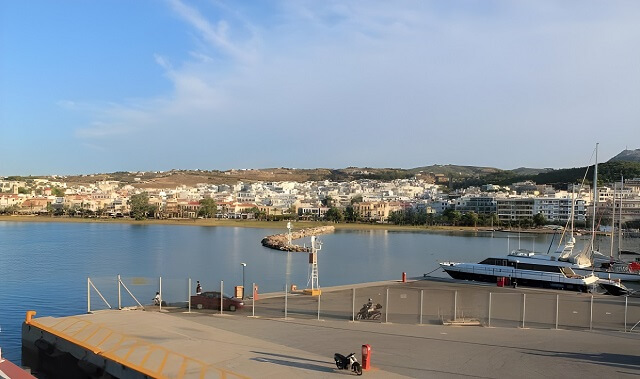
We didn’t stay at the pier too long; during this time we watched other ferries departing toward Santorini
So, on the appointed day we came to the pier from where we were supposed to depart. Ferries to Santorini island depart regularly from the local port. I’ll say right away – always write down your guide’s phone number! Believe me, the money spent on a call is nothing compared to the situation when you get lost, are late, or get into an unpleasant situation.
Sailing away from the island, an incredible journey awaited us. The journey took a little over two hours. We don’t suffer from seasickness, so the journey seemed comfortable to us. And besides, only 2 hours separated me from my dream. Our ferry had two decks; we settled on the upper one so we could observe our surroundings in all their glory. And finally, Santorini island itself appeared.
White stone town of Oia
Santorini island (the more well-known name of Thira island) is part of a group of islands arranged in a ring formation called Santorini.
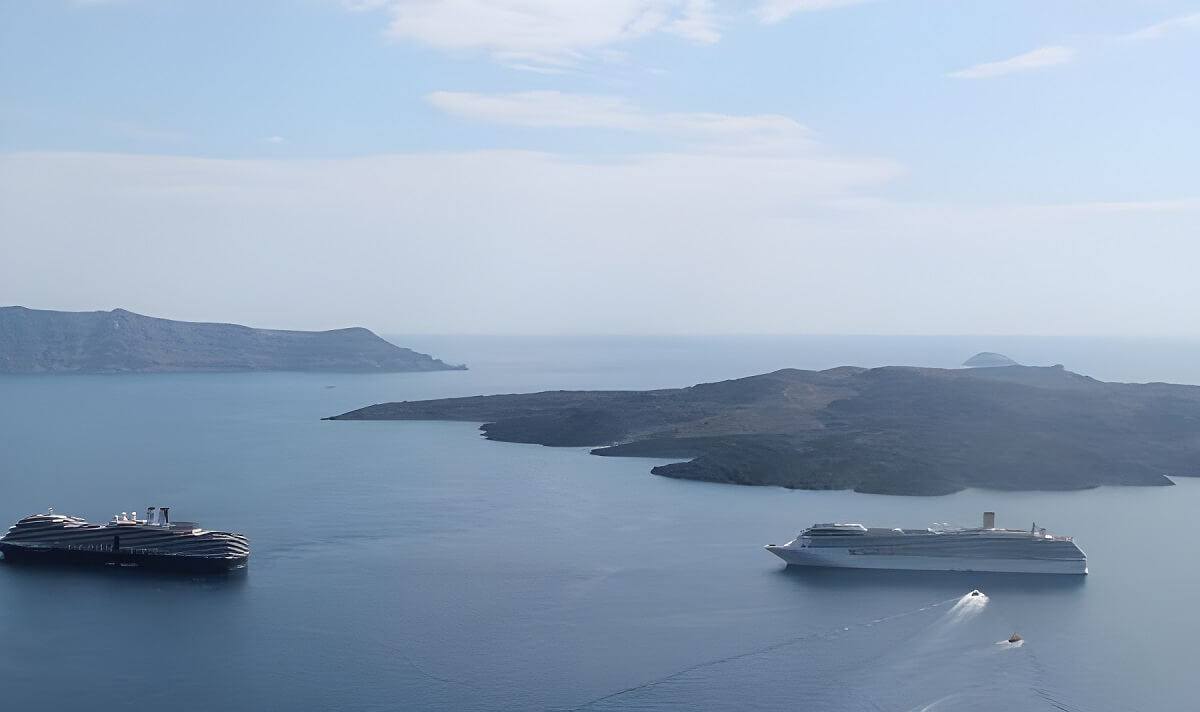
So, Santorini (Thira) is an island of volcanic origin. Originally the island had a round shape, with Santorini volcano in its center. Presumably in the 16th-17th century BC, a powerful eruption of this volcano occurred, as a result of which the crater and central part of the island collapsed, forming a giant crater that was immediately filled with seawater.
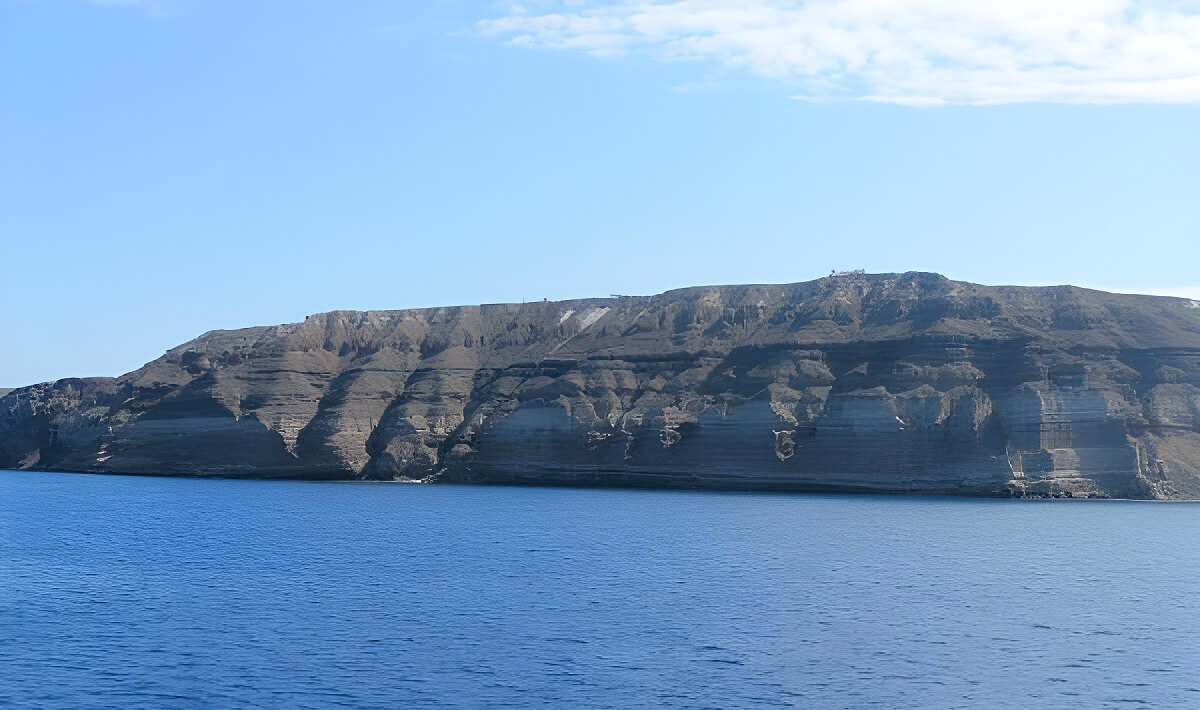
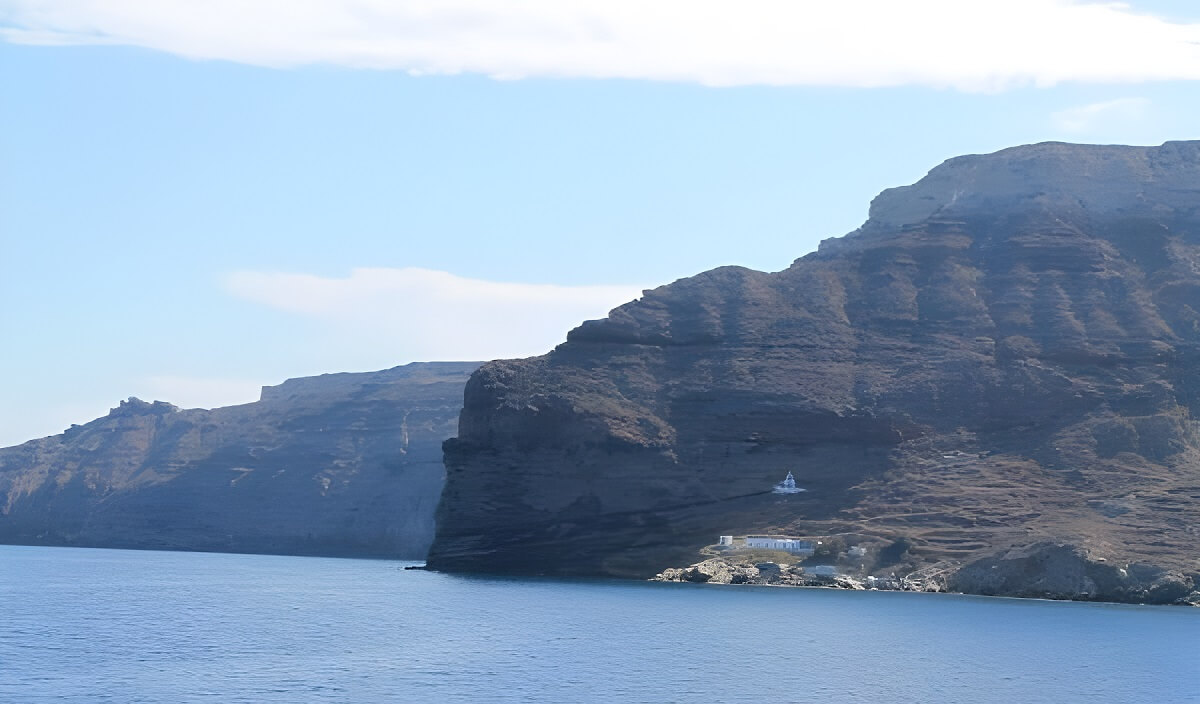
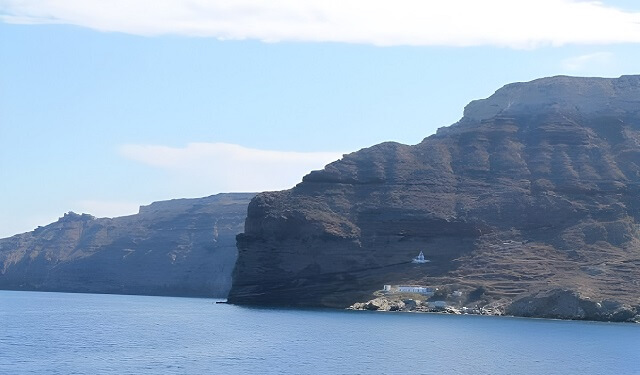
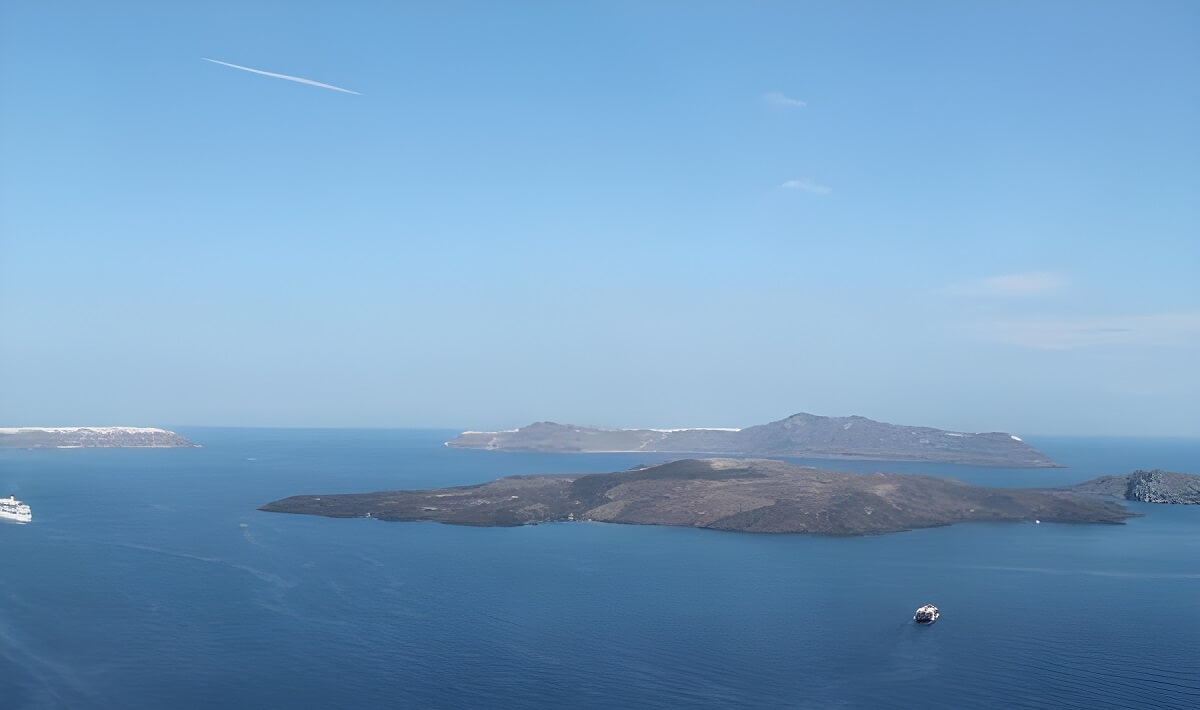
Approaching the island, mountain ranges were already visible. It’s hard to believe that there was once an active volcano in this place, and I wouldn’t really want to see it erupt
By the way, when the volcano erupted in 1956, it was even shameful to say you had real estate on Santorini. Because back then it cost pennies here. And this event happened 12 times. And all 12 times people stubbornly returned here.
Now this is almost the most expensive real estate in Greece, even though the land under the nearby islets is hot.
There’s an opinion that the history of this island formed the basis of the legend of Atlantis. Whatever the truth may be, the thought that Santorini is possibly a piece of lost Atlantis adds additional romance to an already magnificent island.
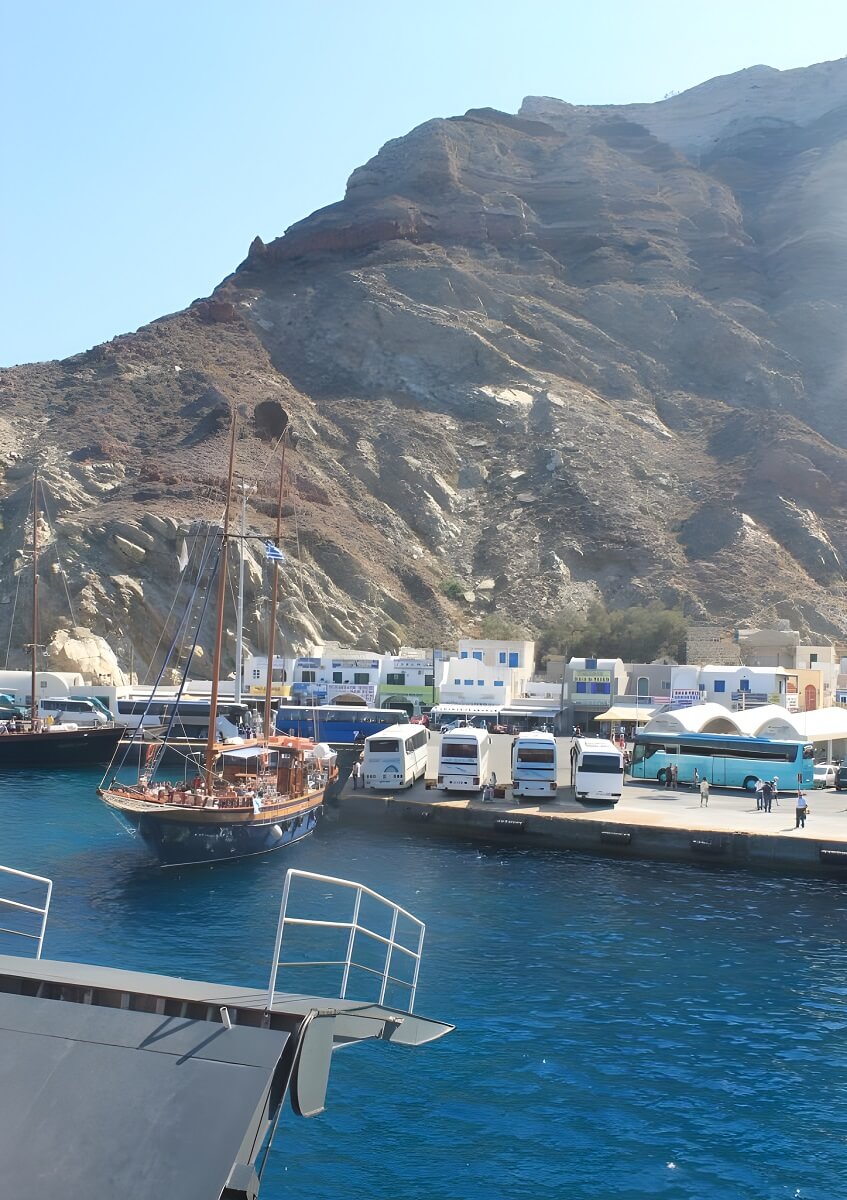
Meanwhile, we’re approaching the local port. At the pier, a bus was already waiting for tourists, ready to take us to see these beauties. The only thing was it was very stuffy inside, even though there was air conditioning, but it apparently wasn’t coping at all.
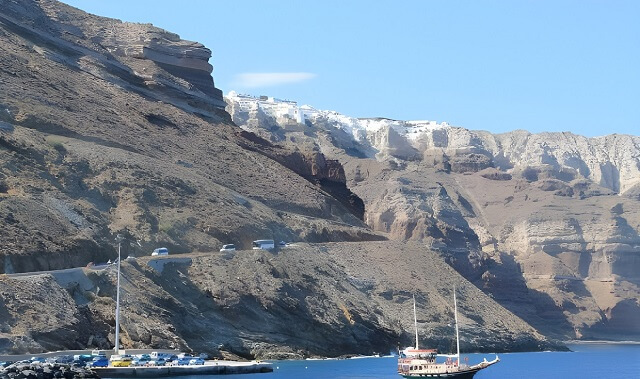
There were many buses standing at the pier waiting for tourists. But that cute little ship caught my attention more, like from pirate movies
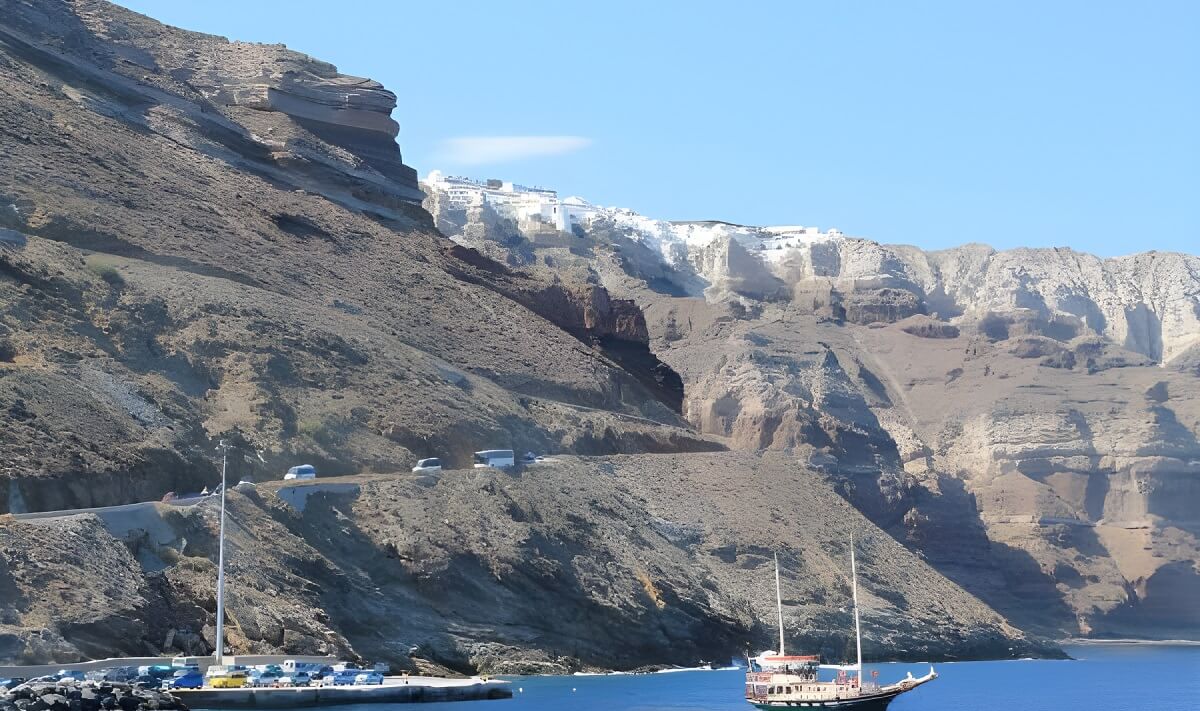
Climbing the serpentine road is not for the faint-hearted; I give credit to the professionalism of local drivers. The whole way it was very scary to fall down, which, fortunately, didn’t happen. But what a view opens up from the height!
I photographed the serpentine while we were on the ship and when we were already driving on it by bus. Honestly, the road to “the dream” looks impressive, and along the way it’s absolutely breathtaking because of the constant climb up and the cliff near the road
The two main towns on the island are Oia and Fira. First we head to Oia.
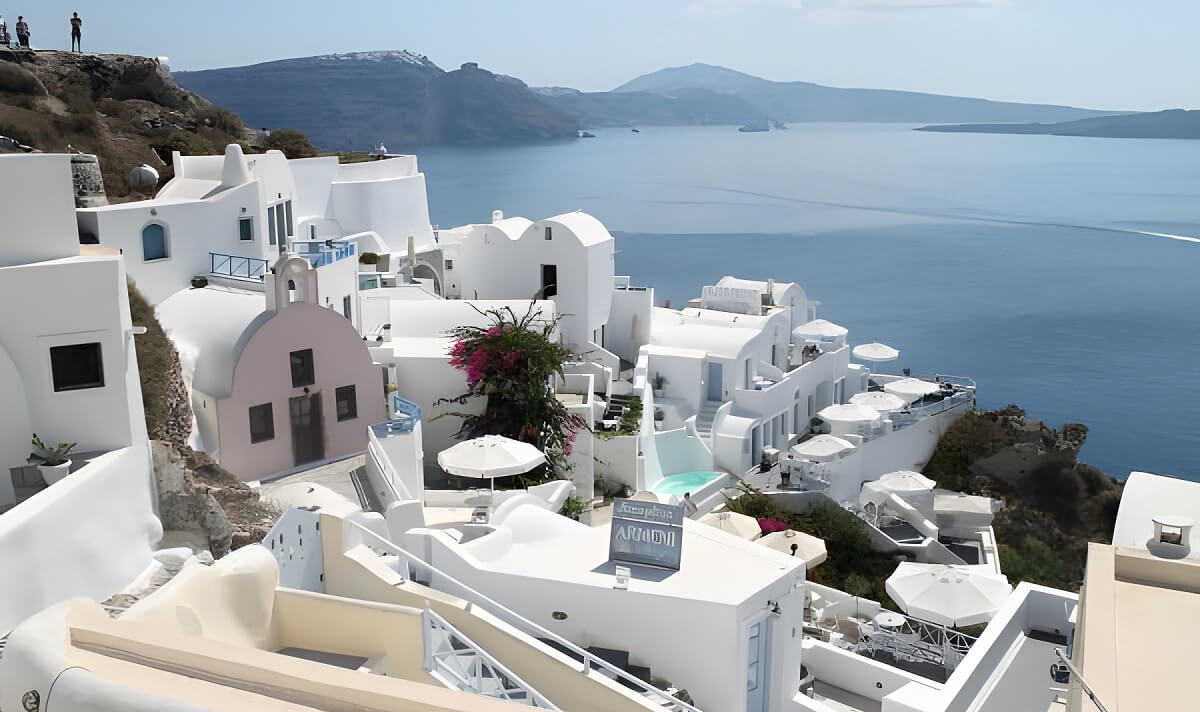
So, the town of Oia (also called Oya) is a small town in the northwest of the island. For many, including me, this town is the embodiment of Santorini island. After all, as a rule, guidebooks or brochures about this island use photos of the town of Oia.
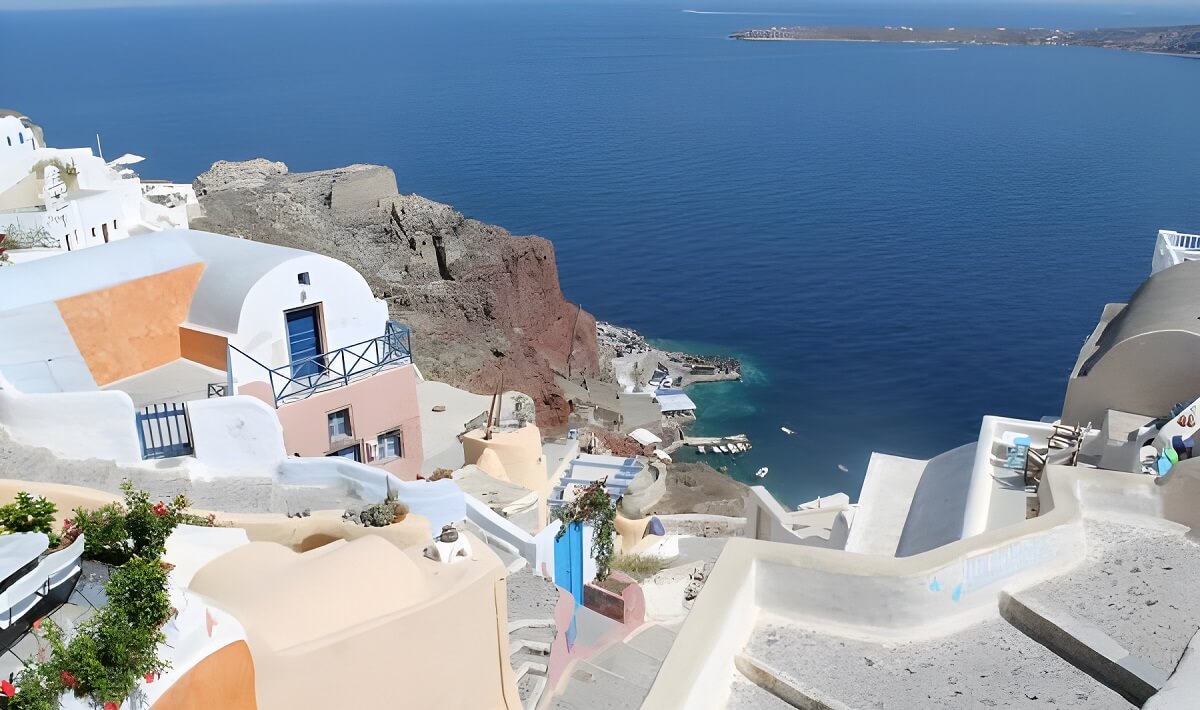
Oia is located on a rocky shore, from where magnificent views of the bay open up. The town itself is small, its area is just over 19 square kilometers. The first mentions of this town date back to the early 13th century.
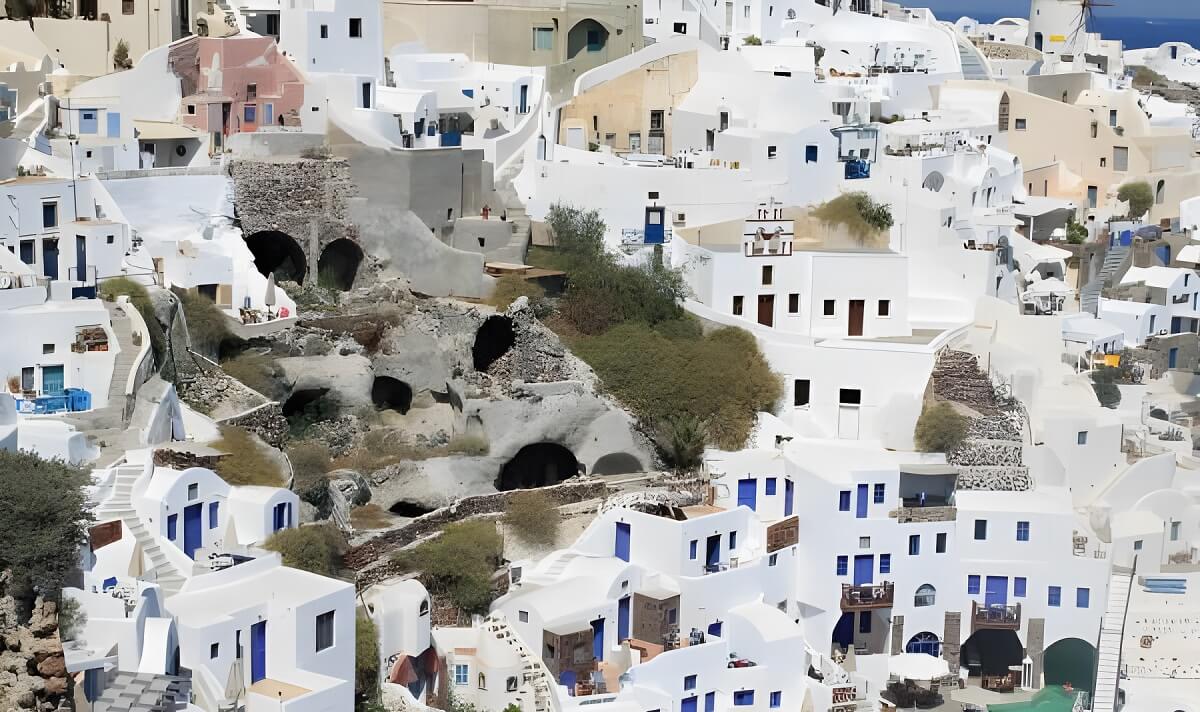
From above, the town looks more like a staircase, and at first there was a feeling that a giant should approach from behind and descend on them down to the sea
What kind of island is this? This is an island whose soil consists of pumice; there’s basically no earth here. And on this “fertile” soil, people live, whose houses are also made of pumice.
Pumice retains moisture, and so in such humidity during the cholera epidemic, cholera itself had room to run wild on the island. Why are the houses white? Because of that same cholera – they’re coated with lime, which is a good dehydrating and disinfecting agent.
The houses aren’t just white, but snow-white. They look so clean and perfect, as if you’re looking not at a town but at a porcelain sculpture
The town of Oia reached its greatest prosperity in the late 19th – early 20th centuries; during the flourishing of maritime trade, this town became a sailors’ town. But later the trade center was moved to Piraeus, and Oia gradually began to lose its position, as a result of which local population migration began.
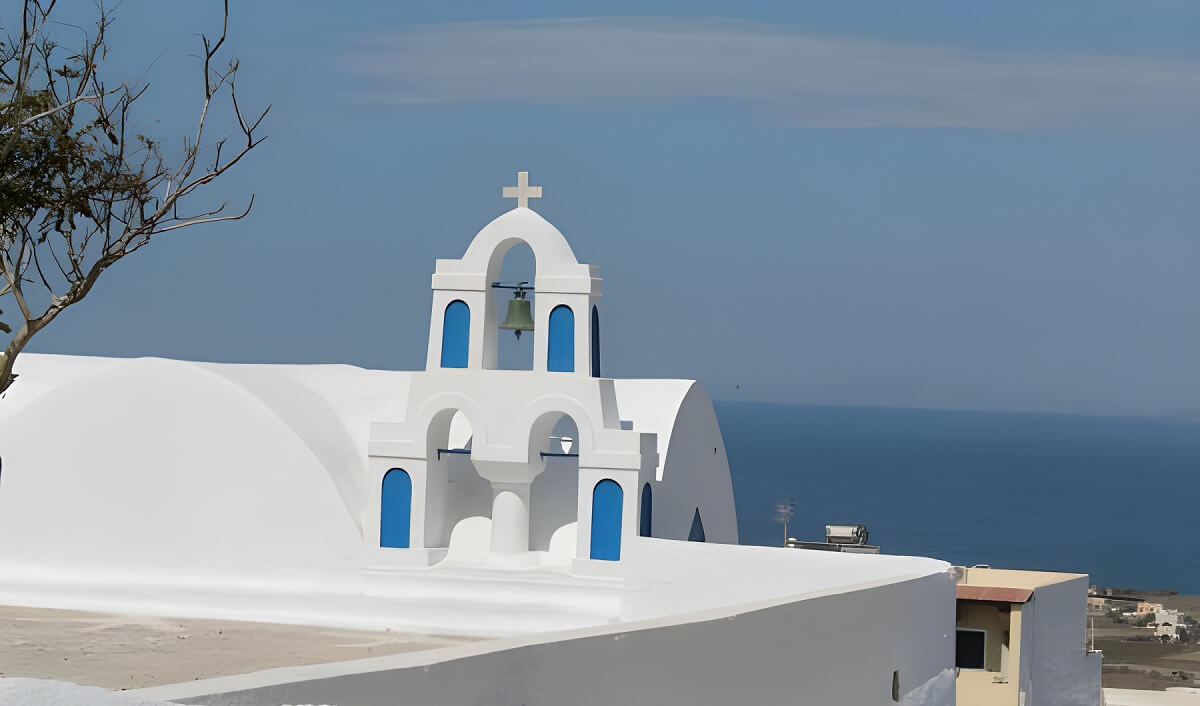
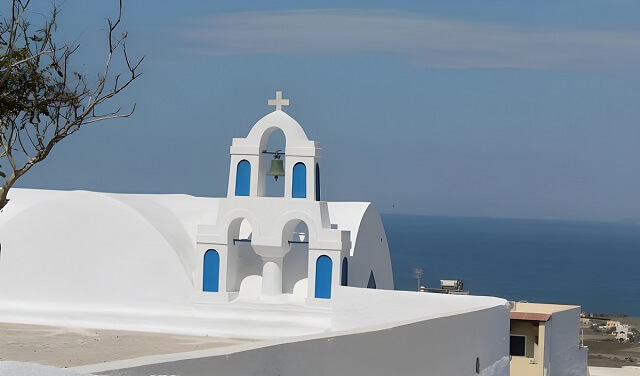
Everything here is maintained in one style: steep climbs and descents, everything white with blue roofs, over 300 churches, hotels and pools.
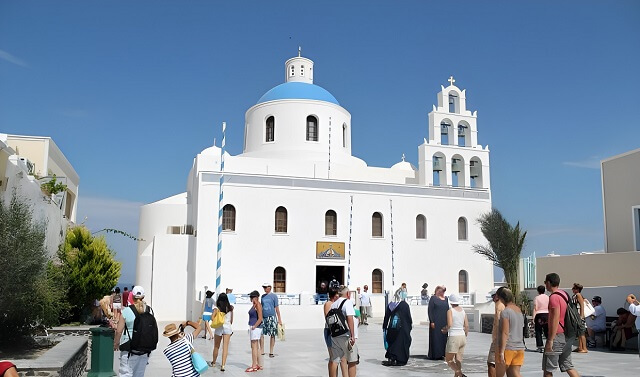
Today, the town is like an exhibition piece for tourists. Being here, you can’t help but notice that there are practically no locals here; among locals – only shopkeepers and cafe and restaurant workers. Everywhere – only tourists.
The complete feeling that if you remove all tourists from the town, time here will simply stop.
Actually, the local population is very small, and in the “off-season” literally a few families remain in the town. The houses here are hotels and mansions of the elite. By the way, a feature of local architecture is that houses look very small from the outside, but actually the premises inside are carved out of rock.
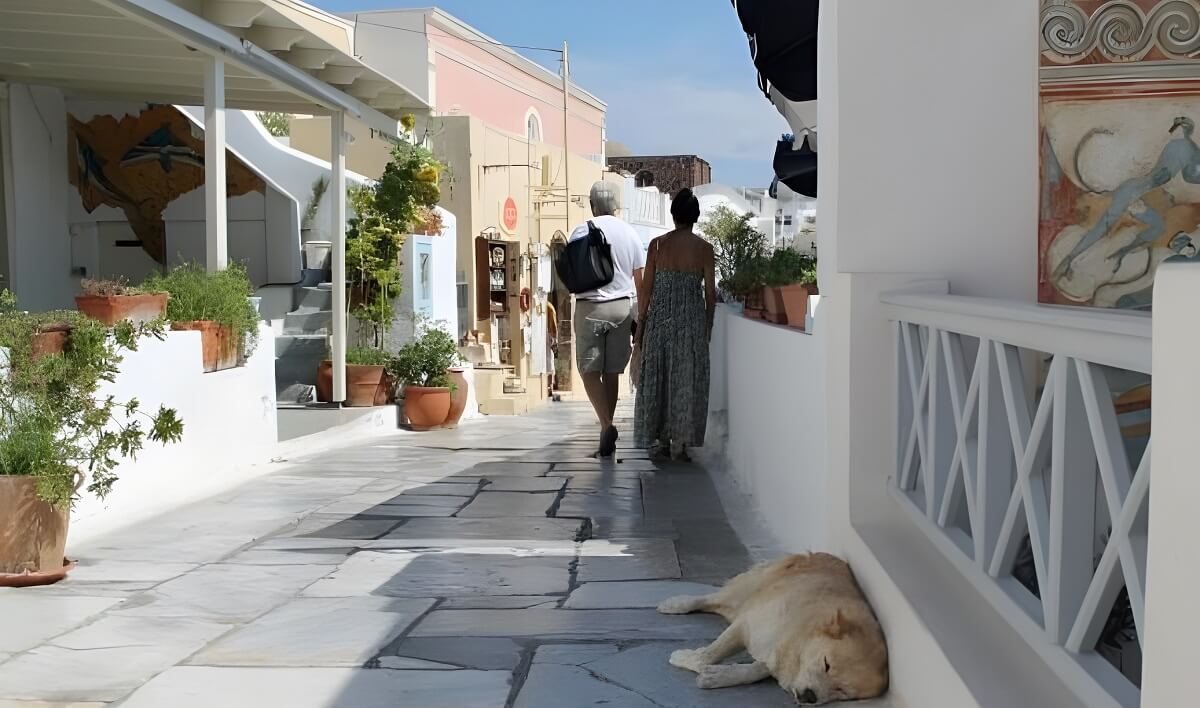
While the dog basks in the shade, we continue moving through the streets trying to bypass the crowds of tourists. Although you can’t really see these crowds here, I assure you, it was just momentary luck
When the season ends and tourists leave, locals close all this beauty, even remove flower pots from yards, and move to the opposite part of the island. Because winds rule here.
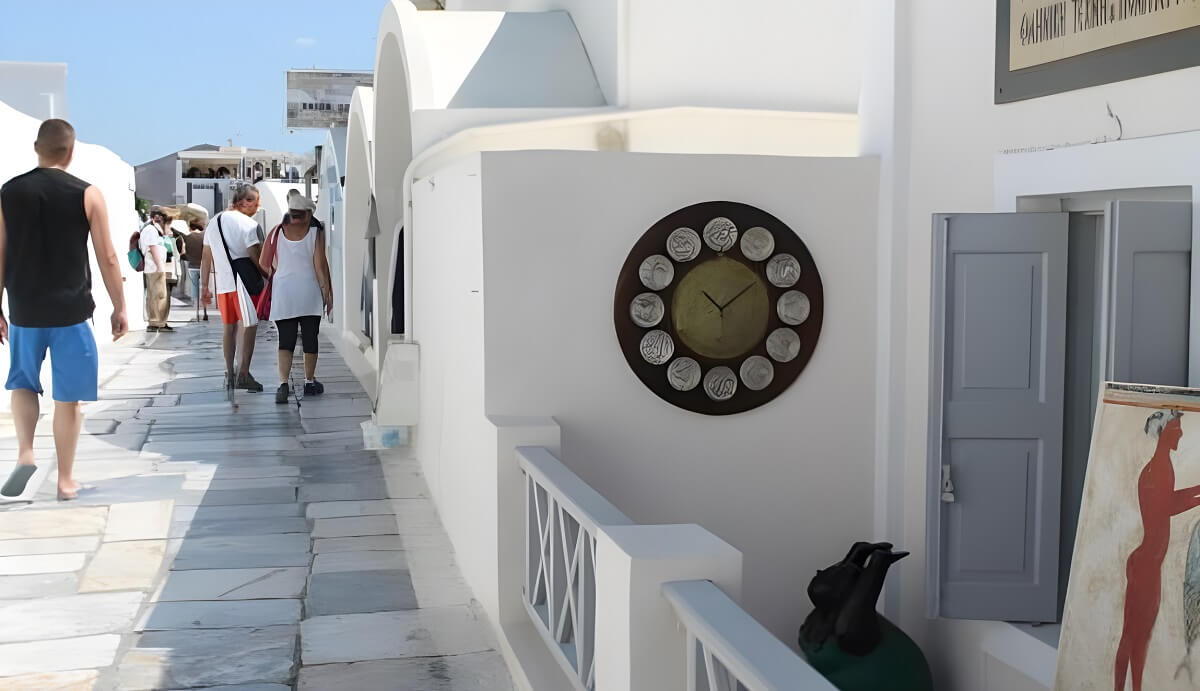
Actually, speaking of attractions, you can safely say that the town of Oia is the local attraction. Narrow paved streets, small white and blue houses against the blue sea create an atmosphere of romance.
All this attracts not only a huge number of tourists from different countries around the world but also makes the town of Oia a favorite place for wedding ceremonies.
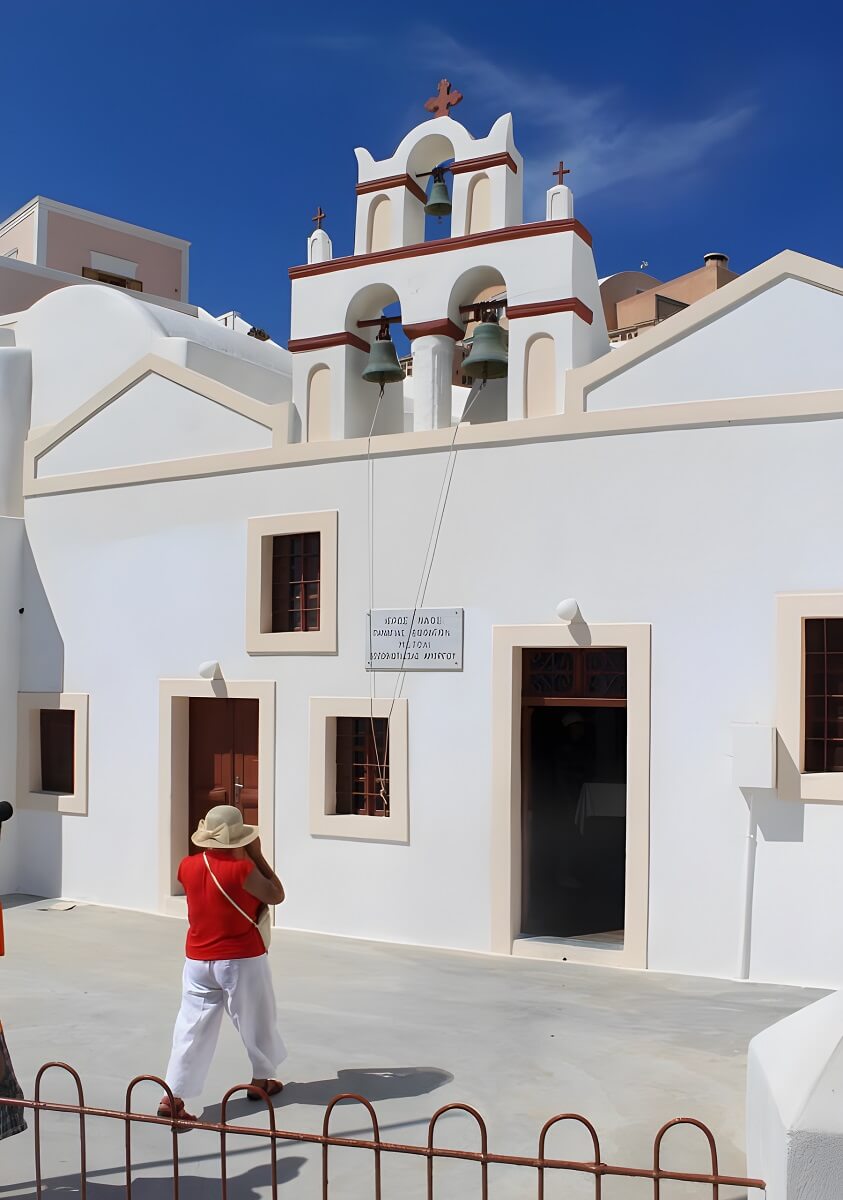
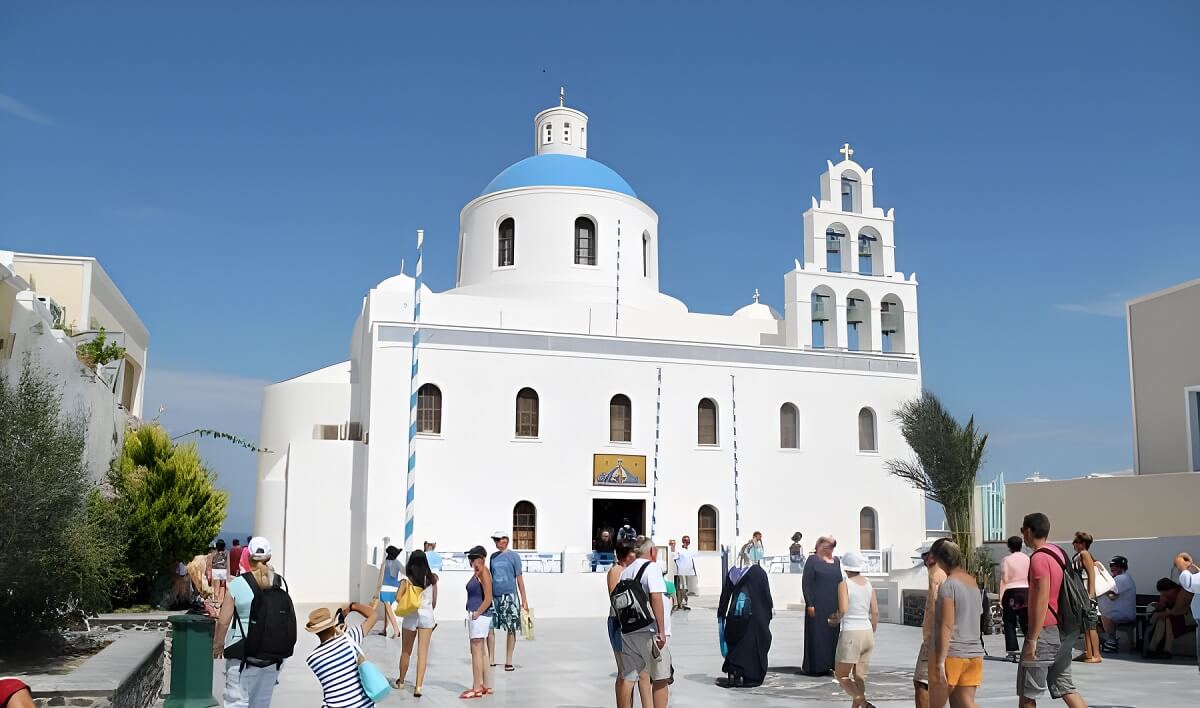
Churches decorate the already beautiful town of Oia. Plus here and there you can find bougainvillea and oleander bushes, and dwarf grapes on the opposite side of the island. That’s it, nothing else grows here.
Churches here are a separate art form; I haven’t seen such beautiful buildings in a long time. I even wanted to attend a service in one of them; what if I meet angels
A huge number of tourists come to this town to see the sunset. It’s believed that the most beautiful sunsets are here.
However, tour time is limited, and it’s time for us to move on. At that moment we regretted not taking a two-day tour to Santorini. But nothing can be done; we’re leaving the beautiful town of Oia and heading to the town of Fira – the capital of Santorini island.
Next stop on our tour - the town of Fira
In terms of architecture, these towns are very similar: the same narrow streets, neat white houses on a high rocky shore with a delightful view of the sea. Only the town of Fira still seems more “alive” compared to Oia: locals are found on the town’s streets, and after Oia it seems that life is bustling here.
By the way, on Santorini there’s even a certain limit on the number of people who can come up to the island during the day (this applies to cruise liner and ferry passengers). Capacity – there’s no getting away from it.
Water and products are brought on such liners together with tourists, since there’s nothing of this on the island itself. Most likely something could have been transported on our ferry too, because consumption here is considerable
Since everything on the island is imported (fresh water, products), prices are an order of magnitude higher than on Crete, for example. Souvenir prices are twice as high, so think about whether you really want to buy a bunch of magnets right here.
Water in taps, in toilets is desalinated, has a salty smell and the same taste. You definitely shouldn’t drink tap water on Santorini!
Returning to architecture – it’s striking here. Houses are built practically on top of each other, so the floor of one house is simultaneously the ceiling of another. I’d say – no privacy on the tiny balconies of local hotels.
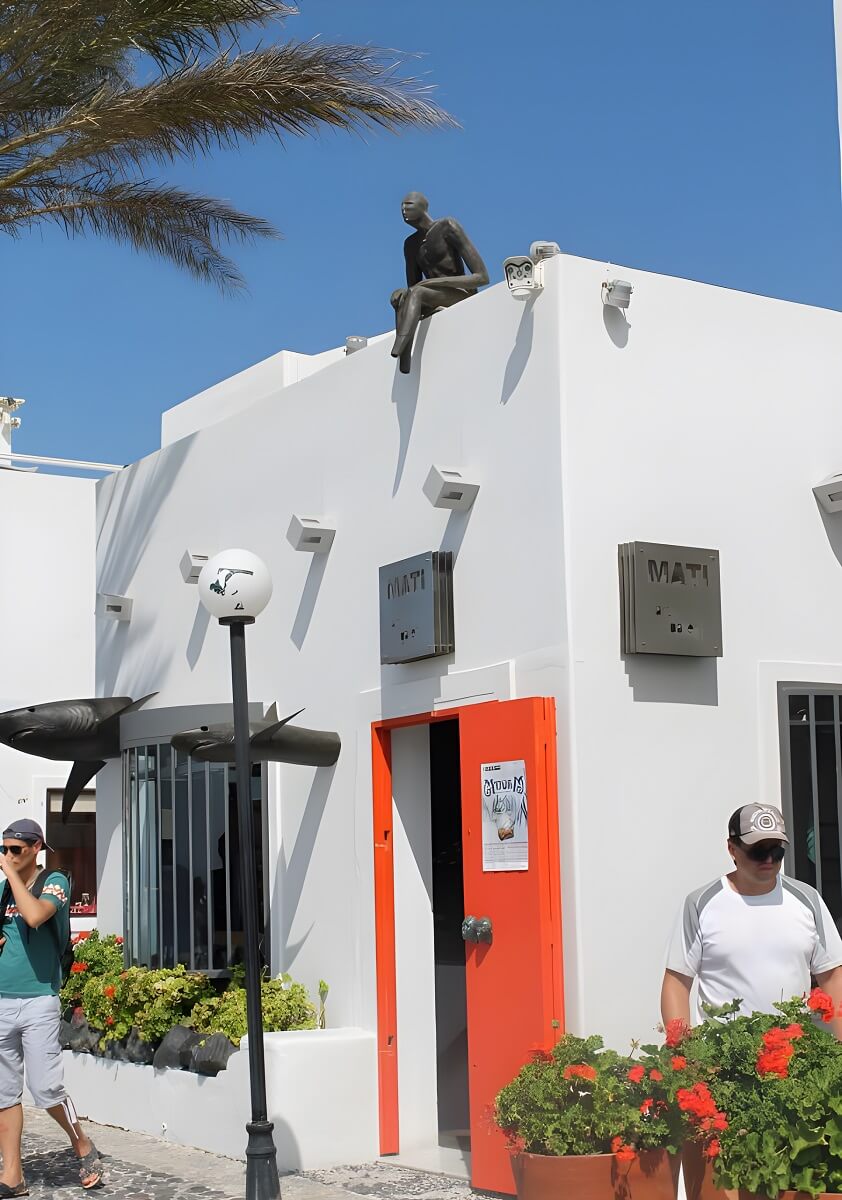
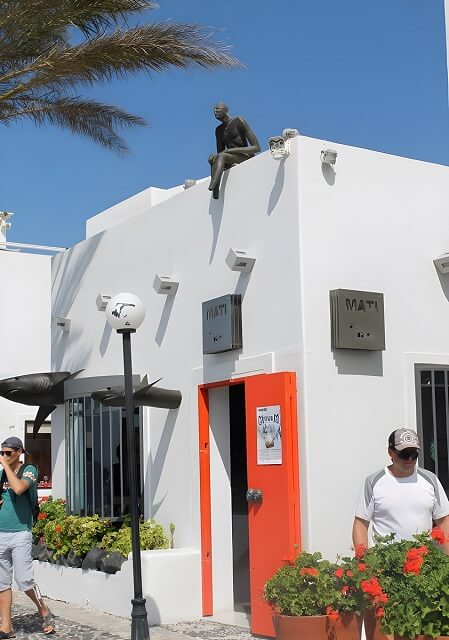
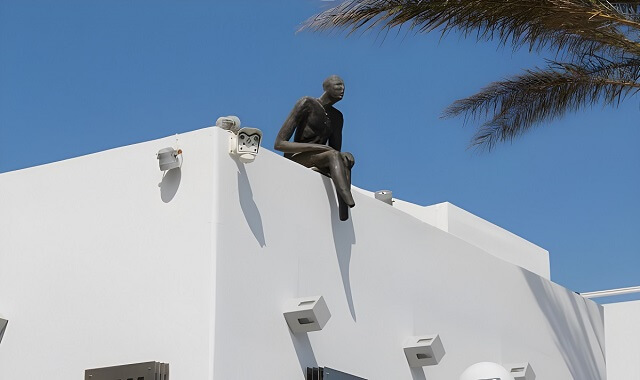
Walking around the town of Fira, it’s simply impossible not to notice the building of the MATI art gallery. It stands out thanks to its interesting design and unusual sculptures that cover the house.
As soon as I saw this building, I got a little scared. Although up close the sculpture doesn’t look realistic, from afar you get the feeling that a person is trying to jump down
The 1956 earthquake also damaged the town of Fira; much here was destroyed and rebuilt. For example, the Catholic Cathedral was built in 1823 but completely destroyed by the earthquake. The temple was restored in 1970.
We had enough time to calmly, at our own pace, walk around these two towns (they’re quite tiny by our standards), peek into every narrow street, into every souvenir shop.
You might think that all of Santorini’s beauty is exclusively in the white and blue houses that have become its calling card. But no! There’s also something to see on the other side of the island. By the way, there’s also a ban on building new houses on the island – it’s a volcano after all.
So, what’s on the other side? Grapes, that same dwarf variety from which famous Santorini wines are made. Although, honestly, I was surprised that anything at all can be grown here; the soil here is very specific.
After viewing the town of Fira, we head to one of the local beaches.
Actually, Santorini’s beaches are a separate island attraction; people come here not to swim but to see them.
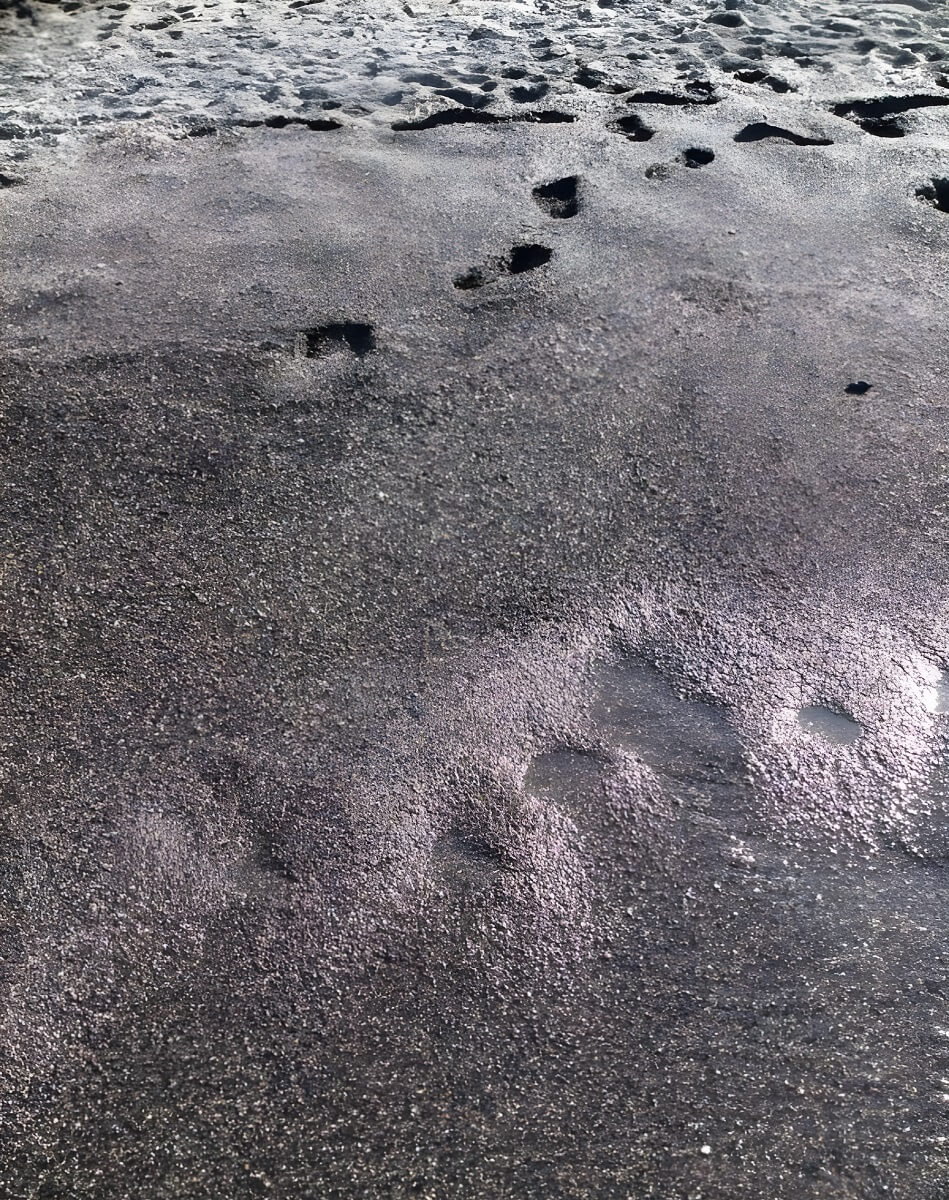
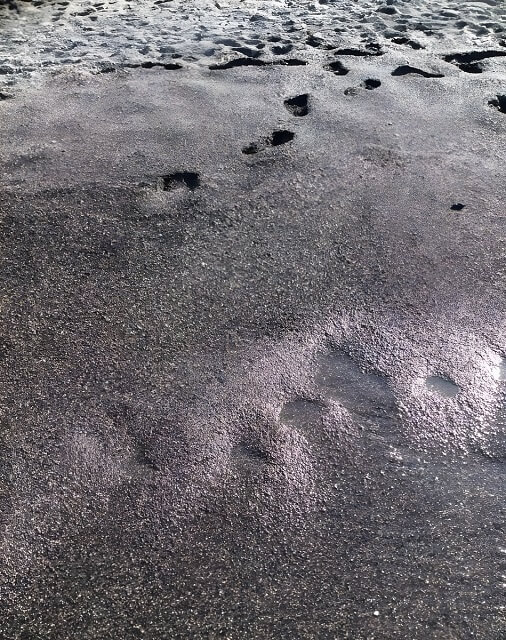
Local beaches have volcanic origin, as a result the sand here is colored in different colors: there are black beaches, white, and even a red beach on Santorini.
We relaxed on one of the black beaches – Kamari. It’s covered with black sand mixed with very fine pebbles.
Of course, up close the sand isn’t really black. It’s more a mixture of stones in brown shades. But the name “brown beach” isn’t very prestigious for such a resort
And after the beach, our group had a choice – either go to another beach, but with red sand, or visit the archaeological site of Akrotiri.
Opinions divided, and people in groups by interest headed in different directions – some to swim and sunbathe, others to an open lesson in ancient history.
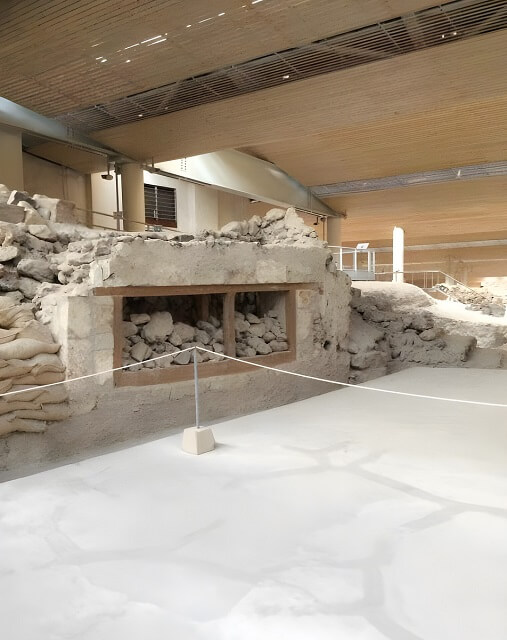
And you know, the beach pales before the opportunity to walk along the street of an ancient city once buried under volcanic ash. The entire excavation zone is covered with a roof, so inside there are very comfortable conditions – no scorching sun.
Seeing excavations in different countries is real luck. After all, this way you can see the ancient history of a city from the inside
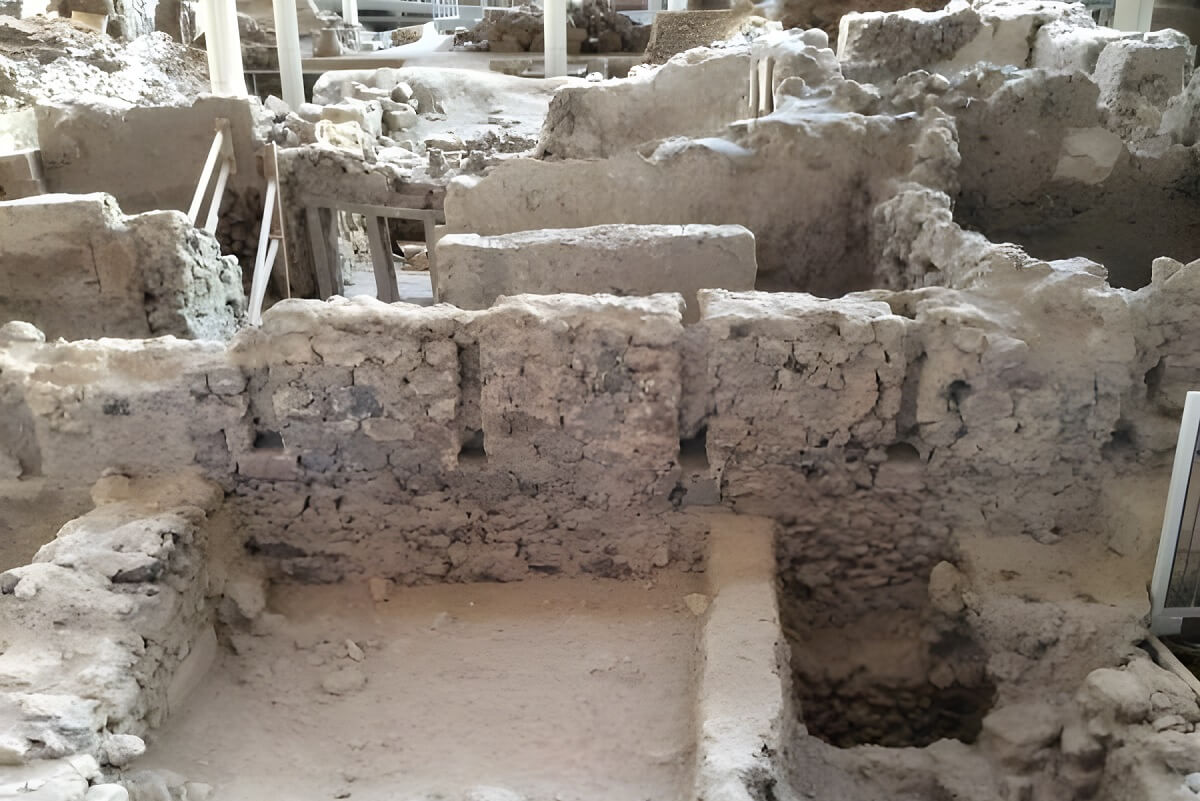
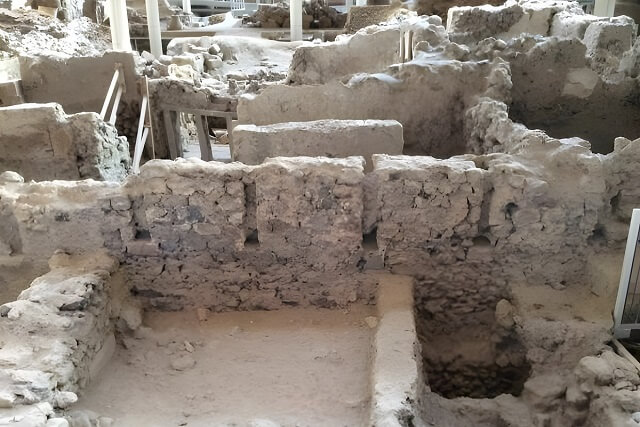
Akrotiri was covered with ash around 1500 BC and accidentally discovered only in the mid-19th century. Three-story houses are excellently preserved.
And during excavations, scientists didn’t find a single human body or even animals, from which they concluded that the population left the city before the tragedy. You can talk about this place as much as you want, but few words can convey the internal sensations from what you see.
I liked this place most of all not only because of its historicity but also because of the coolness that the island really lacks
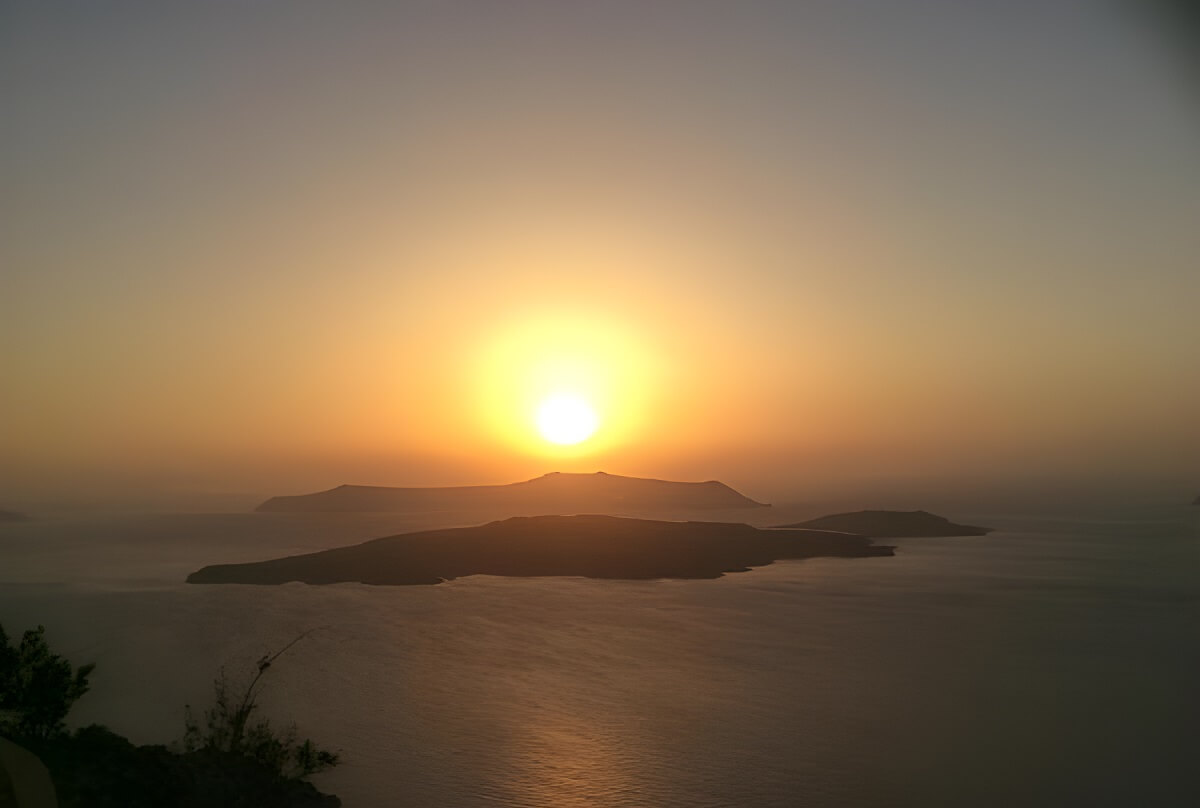
To conclude such a long and eventful day, the real cherry on top is the famous sunset over the volcano caldera. They say even Hollywood stars fly in specially to watch it.
A huge molten solar ball slowly melting in the sky over the youngest European land is truly a mesmerizing sight. And whole crowds of people occupying every balcony, every table in numerous cafes, every free spot from where this celestial extravaganza is visible – is further confirmation of this.
Even the sun looks different here; it’s bigger somehow. Well, at least it’s definitely hotter, which we managed to confirm during our walk
Are there any downsides when traveling around Santorini?
I can’t help but mention the downsides of the trip to Santorini (yes, yes, there are some too).
If you’re going here during high season, be prepared for the fact that on Santorini it’s much hotter than on other Greek islands – there’s practically no vegetation here and, as a result, no shade. Stones heat up mercilessly, and the long-awaited breeze brings only new waves of heat.
Don’t count on being able to fully immerse yourself in your thoughts here, walk along narrow streets and enjoy the local views – besides you, there are thousands of such “wandering” tourists on the island, and everyone wants to grab their piece of unforgettable impressions.
Prices! They’re very high for literally everything: starting from car rental and restaurants, ending with the cost of accommodation in a tiny apartment-hotel or villa.
The scattering of towns across the island, which has very difficult terrain, as well as the absence of a promenade connecting them, makes walking between main attractions impossible.
This isn’t Crete, not Rhodes, and not even Corfu – the main activity here is viewing local beauties. Santorini’s towns can’t be called party or youth towns. The only entertainment is hunting for beautiful sunsets and enjoying the view of houses with blue roofs.
Tips that will be useful to you on Santorini
If you still decide to go to fairytale Santorini independently, you can purchase tickets for high-speed ferries either at the Heraklion seaport ticket office or by taking care of the trip in advance – via the internet.
Those who intend to move around Santorini not as part of an tour group should think about how to independently organize the trip. For this, there are rental agencies on the island where, with a driver’s license, you can rent a bike, ATV (strongly not recommended), or car. Renting a car will cost from 45 euros per day and higher (depending on what car you want to temporarily use).
Be sure to bring hats, an umbrella, or something you can throw over your shoulders – the sun here is very active and scorching. You can get burned in an hour. Sunscreen is welcome, as is comfortable footwear.
If you decide to spend the night on Santorini or stay here for several days, be prepared for the fact that prices for accommodation and food here are much higher than the Greek average. I want to emphasize again – not a little bit, but many times over! Therefore, to save yourself from unpleasant surprises, it’s still better to inquire in advance about a possible accommodation place and estimate your budget.
Even if you have a vehicle at your disposal, prepare for the fact that “swimming and sunbathing” vacation here is hard work – to get to any beach you’ll have to descend and climb hundreds of steps. Loungers and umbrellas on beaches are for an additional fee.
Did you like the article? Share it with your friends: