Kos island holidays: Detailed Guide to Ancient Ruins, Thermal Springs, Local Transport, Authentic Greek Life and Best Time to Visit in the Aegean Paradise
Updated:
The island of Kos, the third largest of the Dodecanese islands after Rhodes and Karpathos, is located in the Aegean Sea. It is called the “Garden of the Aegean” for its lush greenery and luxurious parks. Therefore, tourists are attracted here, first of all, by the unique nature and ecology. However, the island is famous not only for its vegetation – a detailed inspection of all the local attractions will take more than one day.
In this article I will tell you in detail about how to get to Kos island and how to travel around it, what you can see and where to sunbathe on the beaches of the island, as well as where to stay, what to eat and what excursions to go on.
The island of Kos: why tourists come here and whether you should visit it
Kos is the closest Greek island to Bodrum. It is part of the Dodecannes archipelago group of islands (means “twelve”). The island has an area of 290 square meters, most of it is flat land, and only in the East of the island there are small mountains called Dikeos (846 m), Simpiros (428 m) and the Latra hill (416 m).


Panoramic view of the island of Kos, nature has tried to make it attractive
The permanent population of the island is about 30 thousand people. The main activities of the population are winemaking, shipping, fishing, cultivation of agricultural products, handicrafts, extraction of sea sponges and, of course, tourism, which largely determines the image of the island.
About the origin of the name of the island there are quite a number of versions, each of which has the right to exist, but historically unproven. Basically all versions are connected with the Myths of ancient Greece and the rulers of this region. One of the versions also points to the similarity of the name of the island with its Turkish counterpart. During the Ottoman Empire, the island of Kos was called “Istankoy”.
Location map of the island of Kos in Greece
How to get to the island of Kos
Geographically, the island of Kos is closer to the Turkish mainland than to the Greek mainland. I will share the most obvious options for getting to Kos in the right place at the right time.


Map of Kos Island
By Airplane
Regardless of the time of year, there are flights to Kos with connections in Athens or Thessaloniki. The flight from the continent to the island takes less than an hour and costs from 160 euros round trip. The main carriers are local airlines Aegean Airlines and Olympic Air.
Low-cost carrier Rynair specializes in flights to Greece, in particular to Kos. During the sales period to fly to the island from Kaunas, Riga, Frankfurt, Tallinn with one connection – from 50 euros one way.
All flights on Kos are accepted by its only airport Hippocrates, located in the heart of the island. From here it is convenient to reach each of the resorts, a bus ticket costs from 3 to 7 euros, a cab from 18 to 40 euros.
May be useful: see international and domestic flights to Kos at this link
By ferry
There are ferry connections from the Greek capital and Thessaloniki. Ferries of the largest local carrier Blue Star Ferries sail to Kos on two routes:
- from Athens via the islands of Astypalea – Patmos – Lipsi – Leros – Kalymnos.
- or via Syros – Santorini – Patmos – Leros.
Travel time is from 8.5 to 10 hours and the cost starts from 45 euros.
The international port of Piraeus is 10 km away from Athens. Cab to it costs from 20 euros, buses number 40 and 49 connect the port and the city center, depart at intervals of 15-20 minutes, the ticket price – 1.20 euros. Travel by metro on the “green” line – the same 1.20 euros.
All the islands of the Dodekanese are connected by another carrier, Dodekanisos Seaways. Not only ferries, but also small boats run between Kos and Rhodes. Travel time is about 2 hours and the cost starts from 25 euros. To Turkish Bodrum the ferry goes less than an hour, the cost – from 20 euros both ways + 5 euros for border crossing.
Most ferries arrive at the central port of the island, i.e. its capital, Kos.
Transportation on the island of Kos
Public transportation in Kos is by bus. Timetables and routes are posted at every stop. They can be delayed by 10-15 minutes, or even more; the flights themselves are almost never canceled. Suburban buses take you from the capital to every resort and village in the center of the island.
Most sights can be reached on your own. Bus stops are unexpectedly found in the most deserted parts of the island. In the capital of the island there are city buses – from 1.2 euros. In the suburbs, the fare depends on the distance – from 1.5-4.4 euros. Payment is made in cash to the driver or the controller. It is customary to be warned about stopping by pressing a button at the exit.
Cabs are perhaps even more common. The car can be stopped on the road, go to the parking lot or call by phone, ordering for a certain time (this will add about 2-4 euros to the fare). Travel between neighboring resorts (distance less than 10 km) – from 7-10 euros, for 20 km – 22-25 euros. From the airport to the main resorts – from 34 euros.
It May be useful: by clicking on this link and leaving a request for a transfer you can get offers from drivers from Kos airport in advance, with photos of cars and prices, so you can not only save money, but also find a comfortable transfer.
The most popular transportation on the coast is the bicycle. Many hotels give them to guests for free as a bonus. In numerous rental shops 2-3 hours will cost from 2-3 euros, a day – from 5 euros.
From the capital there are tourist steam trains – without rails, on 2-3 open carriages. There are only 4 routes: to Asklepion, to Tigaki, through the city center, through the surrounding villages. The fare starts from 5 euros round trip.
Rent a car on the island of Kos
Renting a car on Kos is a great opportunity to explore the island and visit all the beaches. There are convenient road junctions, good roads, except for the roads that are not paved and lead to wild beaches.
Traffic is lively thanks to tourists who move along the highway on all kinds of vehicles: mopeds, quad bikes, even on their own right-hand drive cars. You should be as careful as possible, as the rules of the road are not always observed by them. There are no traffic jams on Kos.
It may be useful: I have an extensive article on my website about renting a car in Greece, where I told about all the intricacies of this service in the country. If you, like me, like to be independent of the schedule and routes of public transport during travel, I advise you to allocate a few minutes and read it.
In all resorts, tourists are served by dozens of local firms; their offices are also open outside the city, in hotel zones on the coast. As a rule, such companies do not require “freezing” the deposit on the card, do not take the data of the card itself. They check documents less thoroughly, and the cost of services is somewhat lower than that of “networkers”. However, they may offer cut-rate insurance or none at all.
The cost of renting a five-door economy-class car is from 35-40 euros per day, excluding insurance. Discounts start from the second day of rental. You will not have to spend money on parking on Kos. Parking is free at attractions, but in the cities there may be no parking spaces in the season. Most hotels have free parking. The cost of gasoline is about 2 euros per liter.
For those who are going to travel around Kos on their own: in order to find an excellent option of renting a car on Kos island and in Greece in general, based on the “price/quality” ratio, I recommend using the following three services to compare the offers of different car rental companies: DiscoverCars, EconomyBbooking, AutoUrope.
Attractions on the island of Kos
This island leaves an impression of a very nice and homely place for travelers. The familiar landscape of Kos is scattered here and there with small villages, goats grazing near them and ruins of ruined fortresses.


There are ruins of buildings scattered all over the island
The castle of the Johannite Knights
The 14th century citadel is included in all the tourist routes of the island, as it arouses the interest of connoisseurs of medieval history.
The attraction is located in the central part of Kos, about 25 km from the main town. The gate is decorated with the coat of arms of the Grand Master of the Order of the Knights of St. John Pierre de Aubusson.


This fortress has seen a lot in its time
The fortress was able to withstand numerous attacks and sieges and was used to hold prisoners.
There are two chapels in the citadel. Before the fortress was built, there were ancient buildings here, but after the earthquake, only ruins were left in their place. The remaining stones and marble were used in the construction of the citadel.
In many places the walls are overgrown with figs and magnolias. Near the entrance, there is a bus stop. After the earthquake in 2017, the castle is closed for restoration, so you can only see it from the outside.
The best time to visit the attraction is in the summer, because in the fall there is a strong wind blowing at the height. The place also looks very beautiful at night – the walls are illuminated, so even in the dark time of day it is bright.
Ancient Agora
Studying the question of what to see on the island of Kos, pay attention to the ruins of the ancient Agora. They confirm that in the ancient period Kos was developed and trade was actively conducted here. The remains of the agora, or in modern language – the market, are located in the capital of the island and occupy a plot 150 meters long and 82 meters wide.
The entrance to the market is decorated with sculptures. The period of construction of the buildings dates back to the 4th century B.C. In the 5th century A.D., the island was hit by a massive earthquake that destroyed the Agora. However, in 1933, after another earthquake, the remains of the ancient site were discovered. Excavation and restoration work was carried out from 1935 to 1942, during which it was possible to find many valuable artifacts and restore the appearance of buildings.


Ruins of the ancient agora, you can see from them that life bloomed and smelled here
The most significant finds are the temple of Heracles III with a mosaic floor, preserved parts of the amphitheater, the temple of Aphrodite, the altar of Dionysus and sculptures of Heracles and Orpheus.
In its heyday, the Agora was the site of theatrical performances, baths and craftsmen’s workshops were built here. The columns are perfectly preserved, they can fully appreciate the grandeur and luxury of architecture, clarity of lines, perfect symmetry. On the territory of the Agora partially preserved basilica of St. John, built by the Byzantines.
- The ancient Agora is located in the vicinity of the port in Kos.
- Entrance to the market area is free of charge.
Asklepion
The list of interesting sights on the island of Kos in Greece includes the largest temple dedicated to the god Aesculapus or Asclepius. Religious services were held here, and sick people came here to be healed. Hippocrates also studied in the temple.


A panorama of the Asklepion, little remains of it
The ruins of Asclepion were found in 1901 by a group of archaeologists led by a German scientist. At that time, the island of Kos was under the rule of the Turks, so some valuable finds were transported to Constantinople. You can see the remains of the church by climbing to the top of the hill. In addition, from here you can enjoy a marvelous seascape.


You can walk along the streets of Asklepion and examine every stone in detail
Three terraces, connected by a marble staircase, are well preserved. The lower terrace was for study and the reception of gifts. The middle one was used for temples and rooms for medical procedures.
In those times water treatment was actively practiced, one of the springs with “red water” is well preserved. Only the nobility could visit the upper terrace. Over time, the buildings were destroyed and gradually restored.
- Asklepion is open from Tuesday to Sunday (Monday is the day off). The schedule of work of the attraction: from 8-30 to 15-00.
- Admission for adults – 8 euros, children are free.
May be useful: Excursion to Asklepion and the village of Zia
Zia Village
Kos Island sightseeing photos often show the village of Zia. This is a very colorful place where the indigenous people of Greece live. In the settlement you can look at the ancient aqueduct, church, walk through the old streets, admiring the cozy houses and relax in the green, dense forest.
The village is located 14 km from the capital of Kos at the foot of Mount Dikeos. You can get here by rented car or as part of a tour group by bus . However, experienced travelers do not recommend choosing sightseeing tours. Most often guests are simply brought to the village, and the guide tells the history of the settlement. Along the way, the bus stops at all the hotels and collects tourists.


The church with its blue domes wants to blend into the sky
It is much more exciting and cheaper to walk around the village on your own. You can get there by bus from the city of Kos. The cost of a round-trip ticket is only 5 euros. The money for the fare is collected by the driver. The bus arrives at the only stop in Ziya and from here it goes back. Calculate your own time, as the drivers do not wait for passengers and follow strictly according to the schedule.
You can also use rented transportation. The trip will take no more than half an hour. Parking for cars is located near the bus stop.
There are many souvenir shops in the village, but their prices are high. Here you can find really original and valuable things.


Souvenir shops along the streets of Zia village
There is a zoo in the village, entrance is paid, so decide for yourself whether it is worth spending money, because it is small and in the cages there are ordinary rabbits, donkeys, goats.
Moving on, you can see a chapel with a small bell tower, behind it begins the ascent to the mountain Dikeos. If you turn left from the zoo, the road will lead you to beautiful, unfinished houses and an old cemetery. A small church, water mills and numerous taverns are also of interest.
It is better to come here for the whole day, not only to walk around the village, but also to relax in the forest.
Paleo Pili or Old Pili
This city was the capital of the island during the Byzantine Empire. It is located 17 km from the current capital city of Kos. The town, despite its rather abandoned appearance, is the most important historical and architectural monument on the island. The settlement is located at an altitude of 300 meters, on the slopes of Dikeos.
At the top are the remains of the oldest Byzantine fortress, which was built in the 11th century. The location of the defensive structure was of strategic importance – it was here that it was possible to organize a reliable defense of the city and at the same time to monitor the movements of the enemy.
From the height of the fortress the inhabitants watched the coast of Asia Minor, in other words, they could timely protect the city from the Turks’ attack.


As I said, there are plenty of ruins here to explore on your own
During the reign of the Knights of the Order of St. John on Kos, the structure was further strengthened, thus making the fortress a key defensive structure. Today, visitors can see only partially preserved once powerful walls.
Also on the territory of the attraction there are dilapidated buildings of the Middle Ages, baths, the church of Panagia Japapanti, the construction of which dates back to the XI century. Inside the church is decorated with frescoes of the XIV century.
The wooden iconostasis is decorated with carvings and columns that used to rise in the temple of Demeter. In the Church of St. Michael and St. Gabriel, the wall paintings, executed in the XIV-XVI centuries, are clearly visible.


Old Cathedral in Paleo Pili
For many years Old Peel was actively prosperous. This changed after the cholera epidemic in 1830. Today, Old Pili is rightfully considered one of the most colorful sights on Kos.
Haji Hassan Mosque
The mosque, built in 1765, is one of the most beautiful in Greece. Not surprisingly, the Haji Hassan Mosque is one of the most visited sights on Kos.
The building is iconic, as it testifies to the invasion of the island by the Ottoman Empire. There are souvenir shops nearby where you can buy a commemorative gift.


Tourists are constantly walking near the mosque, it is one of the most iconic landmarks of the island of Kos
People come to the mosque on their own and as part of excursion groups. In the dark, couples stroll here, as the surrounding area is beautifully illuminated.
The mosque with a minaret is located near the Hippocrates sycamore tree. The structure is named after Hadji Hassan, the Ottoman viceroy on Kos and the governor of the island. For the construction was chosen the place where a church from the Byzantine Empire was located.
In addition, there is a spring nearby, from where water was taken for ablutions. Today Muslims come here to pray. The building stands out among other religious buildings of Kos with its luxury, oriental decoration.
- You can visit the attraction any day from 9-00 to 15-00.
- During the service, the entrance to the territory is closed.
- It is forbidden to use flash photography inside the mosque.
Beaches on the island of Kos
The beaches of the island are very diverse: long and very small, with white, golden or black volcanic sand, fine pebbles, with picturesque bays. Thus, in some places in shallow waters you can find a natural “Jacuzzi”, where bubbles rise from the bottom. And on the coast near Psalidi there are thermal springs, which contain a lot of sulphur.
May be useful: Hot springs in Greece: where are located, which one to choose, affordable tours, the most popular resorts with hot springs, 10 best thermal springs in the country
Kefalos is one of the most picturesque resorts on the island. From here stretch the famous beaches of Kos: “Kamari”, “Agios Stefanos” (textbook landscape with the ruins of the Byzantine basilica and a coastal islet with a church), “Paradise Beach”. The clearest water and soft sand.
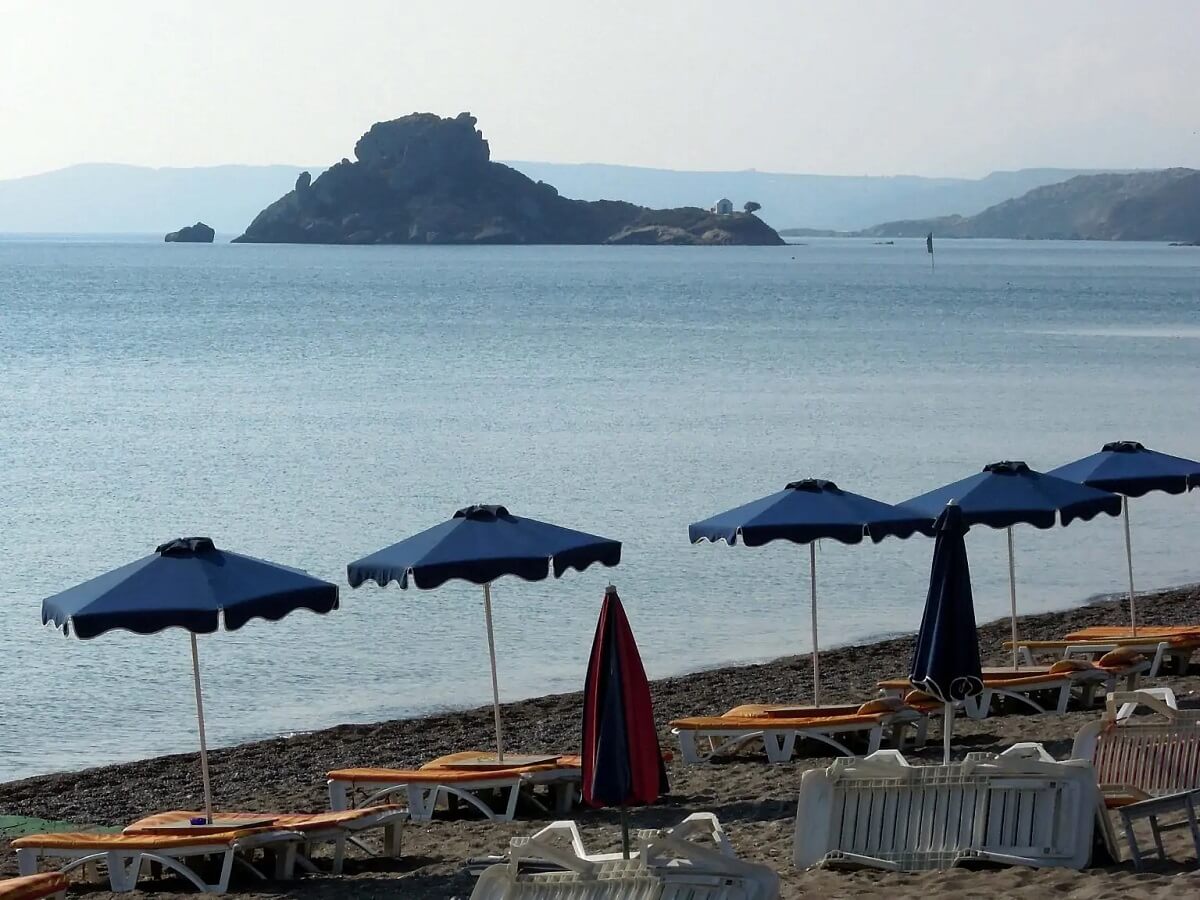

Agios Stefanos beach overlooking the island of Kastri
Kefalos is located 43 km from the capital in the western part of the island. The local sandy beach is cooler than the others due to the currents, but it preserves the authentic architecture of the island, including an old windmill.
There is a well-equipped water sports equipment rental center. The bay is a major windsurfing center due to its location, but the wind is not as strong as on the northern beaches.
All the beaches on the south coast are less windy than those in the north, and the sea is calmer. In addition, most of them are sandy. This makes the resorts in the south of the island a popular destination for vacationers with children.
Kardamena is also on the south coast. About 70% of the nearby beaches are wild: sand alternates with rocky areas, there may be boulders in the sea. Part of the coastal area is occupied by the port. Vacationers who prefer beach comfort, walk 1.5-3 km to fully equipped beaches “Atlantis” and “Banana Beach”.
On the north coast are the resorts of Marmari, Mastihari and Tigaki with a 10-kilometer beach. The sand is fine, shallow, but there are strong waves. On such days vacationers sunbathe, having fenced off from the wind blowing from the sea with special awnings.
The eastern half of the island has pebble beaches from the capital to Psalidi on the northern coast, including Agios Fokas in the southeast.


Tigaki beach with many vacationers on it
On the main beaches of all resorts there are quite a lot of entertainment: boats, catamarans, “bananas”, rental centers for diving and surfing equipment.
On public beaches you have to pay for sun beds. The beach is shared between the owners of taverns – sometimes the price includes a drink or snacks. The price for the use of two sun beds and an umbrella is from 3 to 15 euros. If you order a meal, you use the sunbeds for free. To avoid paying for the rent, you can leave the “sunbed area” and stay in the “uncultivated” part of the beach.
Cuisine on the island of Kos
There are enough establishments of different formats on Kos: not only cafes and restaurants, but also pubs, bars, coffee houses, including “useri”, where coffee is mixed with ouzo. But predominant on the island are so-called “home” restaurants, the owner meets guests right at the entrance.
There are such cafes all over the island: on the main streets, in mountainous (but touristy) villages, in the ports, in the markets.
- The cheapest hot meal is a self-made burger (from 8-10 euros), served with fries. As a rule, the side dish is already included in the price.
- There is a lot of fish and seafood on the menu – from 15 euros for a hot dish (as a side dish more often vegetables).
- Abundance of vegetable salads (Greek – from 8 euros, with seafood – from 10 euros).
- Water and even homemade lemonade in some establishments are served free of charge with the order. Thus, you can have a snack for 10-15 euros per person, a full dinner with wine – from 30 euros. In establishments with a claim to restaurant cuisine – from 50 euros.
The famous “huge” portions can already be referred to the category of Greek myths. Even in home restaurants they are replaced by medium portions.
The second most popular format of establishments is bistros. “Complex lunch”, a burger or sandwich, served with a soda for 10 euros. Approximately the same assortment of food in beach bars. Beer – from 2-3 euros per can.
Pubs with local beer and coffee houses, where Greek coffee is brewed, can be found only in major tourist centers (Kos, Kardamena, Lambi). In the capital, the tourist “street of bars” stretches for almost a kilometer.
Classic English pubs are neighbored with party places where cocktails and shots are mixed.
Kos hotels: where to stay
Tourist centers with hotels and landscaped beaches can be found in different parts of the island. Many hotels on Kos operate on an all-inclusive basis.
In the bay of Kos between the villages of Lampi and Psalidi are the largest and most luxurious hotels with the prefixes Palace, Deluxe, Spa and Adults Only.
The advantages of this location are the proximity to Kos, the capital of the island, the main attractions and all means of transportation (buses, ferries). 10 km east of Psalidi are the healing thermal springs of Termes.
In the west of Kos there are three resort villages: Tigaki, Marmari and Mastihari. The sea on this side of the island is rough, there is often wind and waves, but the beaches are good. From the port of Mastihari there are boats to the island of Kalymnos.
Kefalos is located on the southern tip of Kos. It is the narrowest spot on the island. I stayed in Kos Island Studios apartments by the beach with wonderful breakfasts. Kamari harbor is 1km from Kefalos, from where you can sail to Nisyros 2 times a week.
May be useful: see more hotels, villas and apartments on Kos Island at this link