Meteora Monasteries Guide: Exploring Greece's Ancient Orthodox Sanctuaries Built on Natural Rock Pillars - Complete Travel Guide with History and Visiting Tips
Updated:
If you think that the most beautiful place in Greece is somewhere on the coast with white sand and azure sea, you are wrong. Of course, everyone has different criteria of beauty, but going on a trip and preparing a plan, I asked my friends what they liked most of all in Greece. And all of them, as one, answered that Meteora is a really cool place to visit.
Of course, to be there, you will have to get away from the warm pool, leave the beach and spend half of the day on the road. But what you will see will really amaze you. “Soaring in the air” is the Greek name for the place. And the most important thing to do there is to stay for the sunset.
Today I will tell you how to get to Meteora, where you can stay, what to see and from where it is best to admire Meteora in the rays of the setting sun.
Hanging Monasteries of Meteora in Greece: what is this place and is it worth visiting
Meteora is an Orthodox monastery standing on top of ancient cliffs. Once there was a sea in this place, but it dried up and the bottom began to gradually erode, turning into bizarre sculptures. This place is a bit like Cappadocia, with the difference that there was a sea of volcanic ash instead of water.
The first cells of hermits here began to appear more than 1000 years ago, it is believed that a certain Barnabas settled here in 950, and then other monks began to pull up to him. For two or three centuries, the monastic community they formed lived without any problems. But then, in the 13th-14th century, the lovers of easy profit, like the Crusaders and Turks, came to Thessaly.
Several monks fled from Mount Athos to Meteora. One of them, Athanasius, started the construction of monasteries. There were 24 of them, but only 6 survived to our days – four male and two female. All of them are now active, and you can get into all of them by paying 3 euros.
Brief History of the Monasteries of Meteora
The formation of the mysterious shape of the cliffs in the vicinity of the Meteora Monasteries (Μονές Μετεώρων) occurred at an epoch over 60 million years ago.
The central part of the Thessaly Valley, where Meteora of Greece is located, was once a sea or delta of a flowing river. As a result of tectonic changes, the crust of the earth was uplifted and the waters surged through the Tempian Gorge. Over millions of years, nature eroded the loose rocks of the mountain range, exposing the solid basalt seals.
Today we see a holostone ridge of hundreds of pillars rising above the Thessaly valley.


Panoramic view of the four monasteries in Meteora
The unusual pillars reach a height of up to 613 meters. In the XVI century the monasteries in the majestic Meteora experienced a period of revival and prosperity, the number of brethren increased and the number of monasteries reached 24.
Greece is the birthplace of Orthodoxy, and it is not by chance that in the successor of Byzantium, on the territory of modern Greece there is a huge number of landmarks, monasteries and Christian shrines.
If you are lucky enough to buy an excursion tour to Greece, then be sure to take advantage of the opportunity to make an excursion to Meteora from Thessaloniki and Halkidiki with an individual guide. This place leaves no one indifferent.
The grandeur and elegance of Meteora, unattainable to understand the fusion of the creation of human hands and the nature of nature, all this inseparably generates a special magic of soaring giants, carved out of the solid, with hats – monasteries that covered their tops. The petrified giants look tiredly after the curious wanderer, who unsuccessfully tries to place in his mind what he has seen.
Where are the monasteries of Meteora
In the northwestern part of Thessaly, huge gray stone blocks rise between the mountain ranges of Pindus and Antichasias (Mount Koziakos), where the Pineas River enters the Thessalian plain. Territorially, the monasteries of Meteora belong to the prefecture of Trikala, located 20 kilometers to the east.
Location map of Meteora Monasteries
Where to come if traveling independently
If you want to find the monasteries of Meteora on a map, it is best to look for the town of Kastraki and Kalambaka. These two small towns lie right at the foot of the monastery cliffs.
All visiting tourists stay in them. The towns are unremarkable – countless guest houses, hotels, cafes, restaurants, rentals of all kinds of transportation, stores and souvenir stores.
Kalambaka is larger than Kastraka and more lively. There is a lot of night life here, people hang out 24 hours a day. At the entrance to Kalambaka from Trikala there is a chain grocery supermarket Lidl, where you can buy groceries, because in local shops all the same will be more expensive.
Location of Kastraka and Kalambaka on the map
How to get to Meteor
The monastery complex can be reached from the villages at the foot of the massif – Kalambaki or Kastraki, which are located in central Greece, 260 kilometers south of Thessaloniki and 350 kilometers north of Athens and 100 kilometers east of the city of Larissa.
There are several ways to get there:
- by tourist buses with a group tour;
- on your own by car;
- by public transportation.
There is an Athens-Saloniki railroad line. The train stops at Kalambaka. From the station to the monasteries it is best to take a cab.
To get to Kalambaka from Thessaloniki by bus, you need to make a connection in Trikala. It is necessary to take into account the connection time of the flights. In the same way you can get there from Athens.
If you go by car, then on the highway connecting Athens with Thessaloniki, you need to turn off in the direction of the city of Larissa, going through Trikala.
It May be useful: I have an extensive article on my website about renting a car in Greece, where I told about all the intricacies of this service in the country. If you, like me, like to be independent of public transportation schedules and routes during your travels, I advise you to spare a few minutes and read it.
The Monasteries of Meteora: Between Heaven and Earth
Until 1923, visiting and climbing to the Meteora monasteries was possible only by rope ladders with primitive scaffolding. Nowadays, during excursions, pilgrims and tourists easily climb the steps carved in the rock.
And in those times, especially honored guests and elders were lifted in a woven net-bag on a winch with the help of a simple mechanism designed for the strength of only two people.
According to the description of travelers of the XIX century, who visited Greece, for half an hour of such a lift, “between the earth and the sky”, the whole life passed before the eyes. It could hardly be considered a pleasant excursion.
The ascent in this way took from half an hour to 45 minutes. A worshiper staying in the net was chattering from the jerks of the lifting mechanism and gusty wind, so we had to defend ourselves from the slopes in the swinging net.
The rope of the gate mechanism was changed only if it broke, and the inhabitants took the tragic incident as a special grace of God.
Early XIV century, Greece. The monk Athanasius, persecuted by the devastation of Athos and the whole of northern Greece by the Catalans, arrives here with his spiritual director Gregory. Driven by the desire to create a community similar to that of Athos, he publishes a set of rules for monastic life.
Great Meteor (or Transfiguration of the Lord) Monastery
A little later, 1340, together with other fourteen monks, he organizes a crazy undertaking for those times – the construction of a laurel on the highest rock (613 meters above sea level) and more than 400 above the village of Kalambaka.
More than 600 years ago, calling this splendor the Great Meteors (Μεγάλο Μετέωρο) – “floating in the air”, Athanasius thereby predetermined the name of the monasteries and the whole majestic complex.
From my own observations: when the cool Thessalian valley is filled with the warm breath of wind from the south of Greece, an interesting view opens up – the mountains and the land are clearly distinguishable, and the foothills seem to dissolve into a transparent cloud. The cliffs look wonderful, as if suspended.


Panoramic view of the Great Meteor Monastery
Monastery of St. Stephen the First Martyr
It rises in the eastern part of the mountain range, just above the village of Kalambaka.
It was once the richest of the Meteora community (Μονή Αγίου Στεφάνου Μετεώρων). Its founder is generally considered to be Anthony, the son of a Serbian kraal, who laid the key stone for its construction in the fourteenth century. In the middle of the XVI century the Venerable Philotheus, the second ctitor, rebuilt the kinovia of Archdeacon Stephen.
However, during the reconstruction of the buildings, a fragment of marble with a carved inscription JEREMIAH, dated 1192, was discovered, which gives reason to believe that the available reliable information in history is relative, due to the loss of such after the Turkish occupation.
The modern cathedral was built according to the St. Gorky architectural type in 1798. The nuns keep the honorable head of the holy martyr Haralampios, a priceless gift of the Romanian rulers.
The sacristy contains precious relics: a gold embroidered shroud, rare books, manuscripts, portable icons, and skillfully made crosses for water sanctification.
For a long time this monastery in Meteora supported educational activities in the territory of middle Greece. With the assistance of the abbot and the brethren, free schools were opened in the villages of Kalambaka, Kastraki and Trikale, and orphans were kept in orphanages.
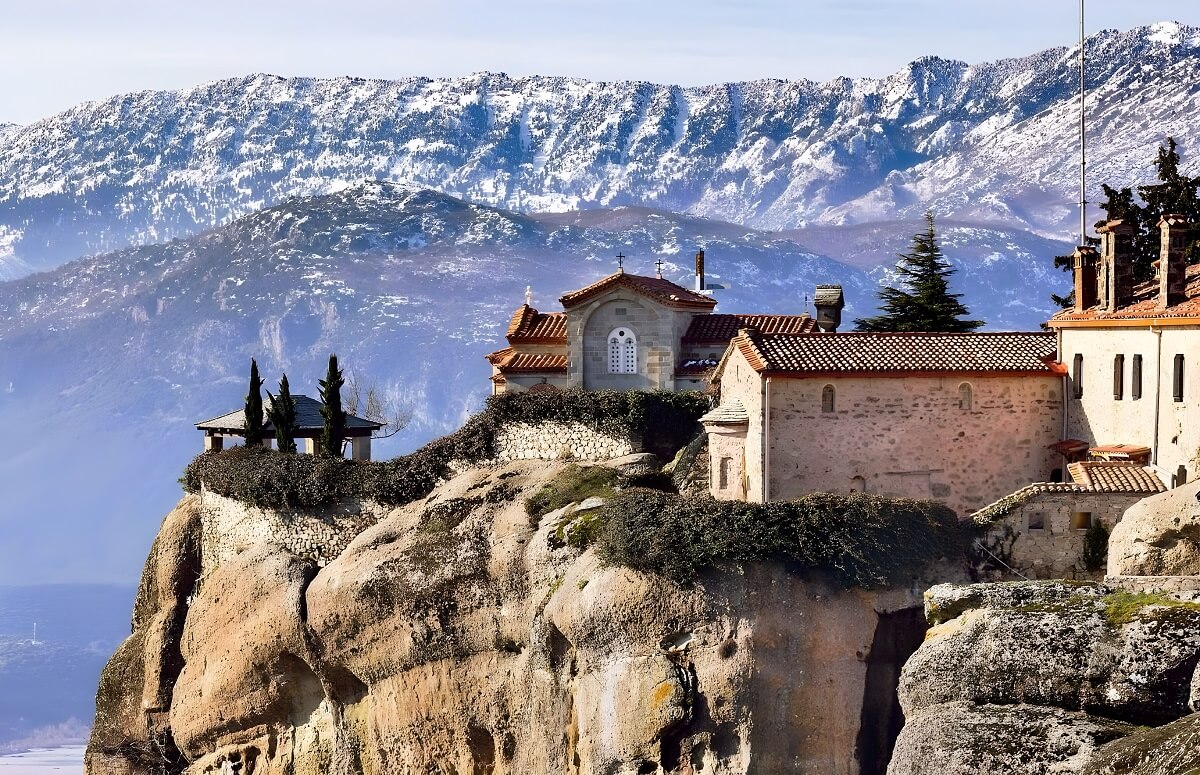


Monastery of St. Stephen the First Martyr
Access to the monks’ hermitage was barred by a raised suspension bridge that hung precariously over the abyss. It has recently been replaced by a fixed bridge. The view from the courtyard overlooking the monasteries and the visible Thessalian valley, filled with blues and greens, framed by the silver ribbon of the Pinhos River, is unusually beautiful.
On occasion, note the abundance of greenery and well-maintained patios. It took several decades to raise the soil for their arrangement on lifeless stones.
In front of the iconostasis are honored the relics of the patrons – the First Martyr Archdeacon Stephen and Haralampius, whose cloister was recently painted and is now a women’s cloister from the sixties.


View of Kalambaka from the Monastery of St. Stephen the First Martyr
Monastery of St. Barbara (Roussanou or Transfiguration)
Access to the hermitage for monks until 1897 was by rope ladders. The gap between two giant boulders was later connected by a bridge. And now wanderers can easily climb up to the monastery.
The name Roussanou (ή Μονή Ρουσάνου) suggests that the first hermit who settled on the cliff was either from the village of Roussanou in the region of Thessaly (central Greece) or derives from the name of the founder of the old temple, who laid the foundations in the XIV century.
In historical chronicles, the date of the renovation of the Cathedral of the Transfiguration and the cells in the monasteries of Meteora is 1545 AD. Hieromonks Maximus and Iosaf, who came from the city of Ioannina, restored the decayed buildings. They are considered to be the second patrons of the monastery.
The modern five-storey complex on the narrow rock, which we see today, was erected in the XVI century, before which time the information is contradictory. There are fragments of information about the founding of the cell of Rusanu by the monks Nicodemus and Benedict in 1288.


View of the Monastery of St. Barbara
Built in the traditional Byzantine style, the temple is decorated with luxurious wall paintings by famous artists of Greece from the mid-16th century on the donations of Hegumen Arsenios. The wall painting belongs to the Cretan school. Most likely it was executed by a pupil of the famous Theophanes of Strelitsa, named Tsortsi.
In plan the cathedral has the shape of a cross. The polygonal dome rests on two columns in the center and two side apse. Like other monasteries, Rusanu was often plundered. The surviving relics and manuscripts are kept in the Monastery of the Transfiguration of the Savior of Great Meteora. Upon entering the narthex of the church, we notice the plot of the Second Coming.
Christ Almighty is placed in the center of the dome, around him all praise God. The whole space of the nave is filled with scenes of martyrdom of the Venerable, who preferred to lose their lives rather than betray their faith. In the main sanctuary the painting is subordinated to episodes from the life of Jesus Christ.


View of the Monastery of St. Barbara
Monastery of St. Barlaam (or All Saints)
A contemporary of Athanasius, the hermit Varlaam climbed the ridge by hammering wooden stakes into the sandstone crevices with the help of ropes and rudimentary scaffolding. With a small number of brethren from nearby monasteries he managed to build a chapel on the peak and several cells, which after his death fell into disrepair and collapsed.
The second citators of the monastery of Barlaam (ή μονή των Αγίων Πάντων ή Μονή Βαρλαάμ) were two brothers from the city of Ioannina, in northwestern Greece, Nectarius and Theophanes of Apsaras. The brothers devoted their lives to God, removing themselves from worldly temptations.


View of the Monastery of St. Barlaam
After living in the Monastery of the Transfiguration for about seven years, they decided to rebuild the ruined chapel on a neighboring rock. The number of brethren who came to help steadily increased, and soon the question arose of building a spacious cathedral capable of accommodating all the novices, as well as new cells with an extensive farmstead.
The hermitage was erected according to the canons of Mount Athos: cross-dome architecture, with two apses in front of the altar part, creating an unusually beautiful effect of sound during the service. The painting of the central cathedral was done in two stages.
The masters, who created the unsurpassed masterpieces of Meteor painting, combined Orthodox traditions with Italian icon painting technique, which is manifested in sharp contrasts of colors of reproduction of the images of the Great Martyrs.
On the territory of the monastery are located: a working museum, storage for food and wine with a preserved barrel of 12000 liters and a platform on the edge of the ledge with a working mechanism for transporting goods.
The delivery of materials is still carried out traditionally by rope. The rope has been replaced by a steel cable and the net by a metal cage, but the principle of delivering goods to the top of the cliffs has not changed for more than 700 years.


Interior architecture of the Monastery of St. Barlaam
Holy Trinity Monastery
It is perhaps the most ascetic and the most difficult to reach of all the dormitories. A lonely pillar, surrounded by a roundel of stone guard giants, shares the abyss with the neighboring hulks. An ignorant traveler will never find the narrow path leading to the foot. 140 steps lead to the top of the monastery.
At the entrance to the monastery yard, on the left side there is a church dedicated to St. John the Baptist – a round-shaped niche cut out in the monolith, the size of a small room. In the southern wing the main cathedral of the Holy Trinity is planned. The cross-dome architecture of the temple was erected according to the canons of the Lavra of Mount Athos. The wall frescoes inside the church are in good condition and date back to the middle of the XVIII century.


View of the Monastery of the Holy Trinity
In addition to the usual buildings, such as kitchens, dining rooms and cells for monks, each monastery has a water collection tank carved in stone. The lack of a water source on the peaks of the Meteora cliffs made it a priority for the ascetics to create reservoirs to collect rainwater. Decades of hard work and prayer also raised the soil for growing fruits and vegetables to the height of the cliffs.
The construction of the Trinity (ή Μονή Αγίας Τριάδος Μετεώρων), according to chronicles, took 18 years, and the supply of materials for construction as much as 70! The courtyard offers a dizzying panorama of all the ascetic asylums in operation.
The courtyard is filled with tourists who come to Greece on excursions and try to capture themselves against the background of the sights. But not a single photo could come even a little bit closer to the feeling of standing on the edge of the cliff overlooking the cliff of Trinity.
Monastery of St. Nicholas of Anapavsas
The shelter between the ruined cynovia of the Baptist and Agia Moni is dedicated to St. Nicholas, the patron saint of sailors, bishop of Myra of Lycia, especially revered by the Orthodox.
Due to the fact that the coverage of the plateau is small, the buildings rose in height by several tiers, filling the hollows and enveloping the hills. The sanctuary is harmoniously blended into the landscape, preserving the strict architectural identity inherent in Orthodox churches.
To get to it, you have to overcome eighty steep steps. The remains of the old wooden staircase (originally it consisted of 62 steps), with the help of which skitniks ascended to Meteora, can still be seen.
A flight of stairs leads us to the chapel of St. Anthony, the former repository of the relics of deceased hermits, with frescoes of the XIV century preserved in the conch. Manuscripts and sacred relics were also kept here.
On the first tier there is an exhibition hall. Having overcome several steps, we find ourselves in the narthex. Due to the limited size of the cynovia, the narthex served as a monastery courtyard, where the brethren would read and perform obedience during the hours when there was no service.


View of the Monastery of St. Nicholas of Anapavsas
The frescoes in the cathedral were painted by Theophanes of Strelitsa (Cretan) by Hierodeacon Cyprian. This is stated by the ctitor’s inscription above the entrance with the date of completion of the painting of the monastery of St. Nicholas Anapavsas on October 12, 1527. Subsequently, Theophanes of Crete painted the monastery of Stavronikitis on the Holy Mount Athos and the refectory of the Great Lavra. And actually brought a fresh stream to Byzantine painting, having borrowed decorative motifs from the Italian Renaissance, he proved to be an example for later artists to follow.
Noteworthy is the scene of the Second Coming of Christ, where the image of the Savior – a just judge – is placed at the top. To the right and left of him are depicted the apostles sitting on thrones. Under Christ’s feet there is a plot of the preparation of the throne with kneeling Adam and Eve, below – the scales of justice.
On the left is shown the arrival of the righteous in heaven, below are gathered before the gates of Paradise. At the door stands the Apostle Peter with the keys to the gate, and in Paradise is depicted Abraham surrounded by children symbolizing the souls of the faithful. The first to enter Paradise is a just robber.
On the right, the painting is dissected by the fiery river of hell from the mouth of the dragon. From above, an angel with a trumpet announces the resurrection of the dead and the beginning of judgment. Incarnate images of the earth and sea bring back the dead from their depths. The eastern wall depicts the founders of the monasteries and the Righteous Saints of Meteora.


Frescoes in the Monastery of St. Nicholas of Anapavsas
Upper levels
From the narthex leads the entrance to the small church, designed for only five stasidia. There are no openings for light in the dome (except for one small window), as two more tiers of the monastery rise above.
The plot of the sanctuary painting is dedicated to the twelve most important feasts of the church year and begins with scenes of the Annunciation, Nativity, Purification, and ends with scenes of the Crucifixion, Ascension and Pentecost.
The peculiarity of the pictorial decoration is that the scale of iconographic episodes is comparable to the size of portable icons. And the impeccable technique of execution balanced clear contours of figures with bright colors in vestments, typical of Western art.
On the second tier there is an archondary for receiving pilgrims, a kitchen and a gate for supplying the necessary goods.
The third tier is occupied by the former monastery refectory, converted into a library, decorated with frescoes, as well as a water tank, monks’ cells and a wide balcony with a panoramic view.
The top of the monolith is crowned by a bell tower with a wide platform.
Monastic prison, ruined monasteries and sketes of Meteor
If you go up from the village of Kastraki, along the dried-up riverbed, you invariably come to a dungeon pillar called “filaki” (prison for novices). At its base is a mouth, wide at the bottom and gradually narrowing to the top, like a triangle. Behind the entrance to the cavity stretches a cave, and above the cave, in the sides and in its depths go inside grottoes of different volumes, no less than fourteen.
To all the passages lead artificial recesses, of which now only beams, timbers and the crocks that supported them remain. In these dungeons were kept guilty ascetics. The huge cave was once walled off, the remains of which are visible to those descending the road from Rusanu.
A dungeon church was built over the entrance. In 1751 priest Rizo painted a small icon of the Mother of God for it, now it is protected in the Rusanu monastery. Now only the recesses in both sides of the grotto, where the beams for the floor and ceiling of the church were inserted, and the hollow where the altar was kept, have survived. In this prison all the prisoners in Meteora and the voluntary hermits who kept them were listening to the sacred services.
At the exit from the cave, in a special piece of rock, a hollow was carved in the form of a deeply concave mirror or dish, placed sideways. The dungeon keeper used to sit here, but now only sometimes shepherds drive their sheep and goats in.
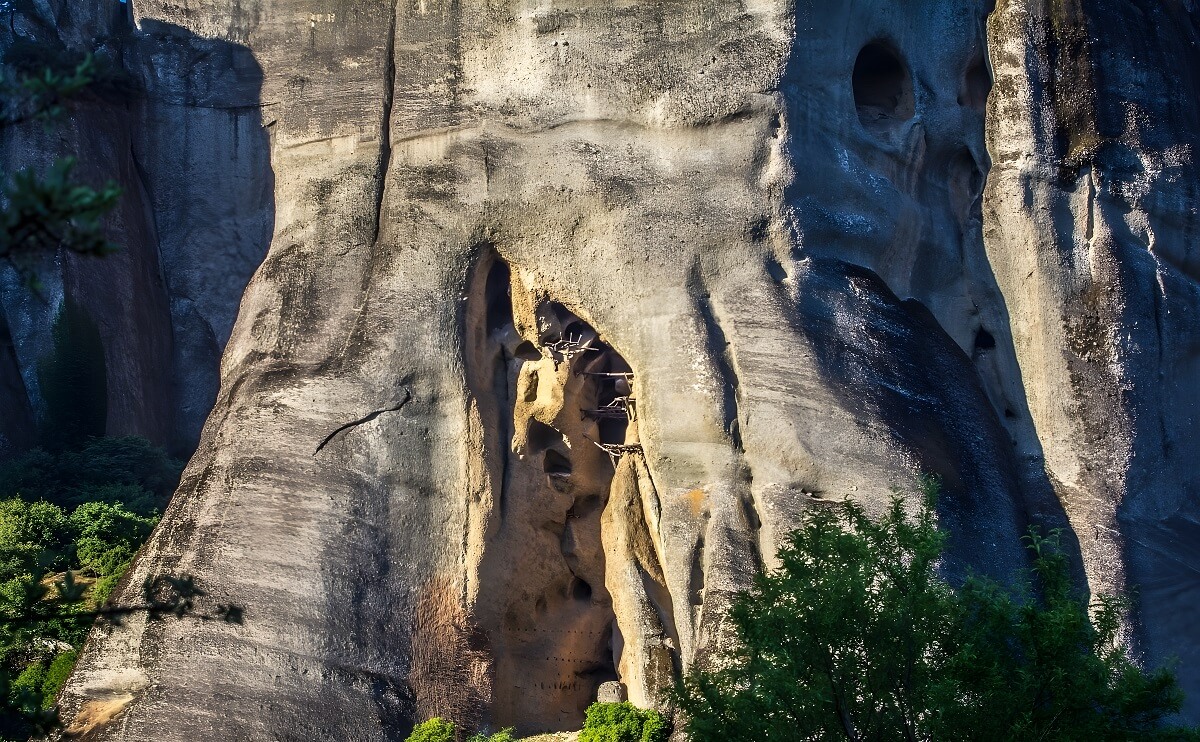


This is what this prison for the monks in Meteora looks like
Agia Moni
From the dungeon pillar it is very close to Nicholas Anapavsas and Dupiani.
On a boulder neighboring the church of St. Nicholas Anapavsas was the monastery of Agia Moni, erected on the heel and edges of a very high and narrow rock. In 1710 the church was deserted, then in February they made an inventory of its utensils and sacristy.
The things were moved to the cathedral church of Stagon. On the condition that when the desert dwellers settled on the pillar, they would return the inventoried utensils and pay 5 piastres for the transportation.
In 1771 the wall was erected at the expense of Gabriel. In 1790, the priest Gabriel (we must assume it is the same person) from the village of Abelaki donated to the church parts of the relics of St. Mercury and St. Makrina. He died in Agia Moni on August 25, 1792.
In 1821 the church, consecrated in memory of the Nativity of the Mother of God, was painted by Christodoulos from the Epirus town of Janina on the funds of Captain Athanasius Mandalopoulo and the priest of Kalambaki Efthimius Duki.
In December 1858 there was an earthquake, then the middle building of the monastery collapsed, only the marginal walls survived.
On the same line with the stone steepness of Agia Moni, but closer to Varlaam, on a huge basalt pillar stood the cell of Ipsilopetra (the highest). In 1650 it was already called a monastery.
The destroyed monasteries of the Holy Spirit, St. George’s Monastery and the Monastery of the Forerunner can be seen from the shadow of the Nikolsky pillar. The rock of the Forerunner is narrow and low, and therefore the monks could not build anything but two cells and an elevated tower on it.
Where to stay while visiting Meteor if you are traveling on your own
The cost of renting accommodation in June starts from 65 Euros per night (for a family of 4). Yes, this is a very popular tourist spot and everything is expensive here.
We managed to find a cheaper option on Hotellook in Kastraki. A woman rented us an apartment for 48 Euros per night. The house turned out to be perfectly clean, neatly tidied and cozy – I can safely recommend it.
The main advantages of stopping in Kastraki rather than Kalambaka are quietness, no big traffic on the road and lower prices for accommodation. Most importantly, from here you can get to the serpentine leading to all the viewpoints faster! Probably, for photographers who want to make beautiful sunrise and sunset shots, this is very fundamental.
May come in handy:
- hotels and apartments in Kastraki
- hotels and apartments in Kalambaka
Where to photograph from: observation decks
All the lookouts are on the serpentine road leading to the monasteries. Each of these sites has a parking lot where you can leave your car. However, you should take into account that the closer you get to sunset, the fewer places are left. But people also park their cars at the edge of the road – nobody cares about it. This serpentine is mainly used only by tourists.
The most popular places to see off the sun are only two.
The first one offers this view:
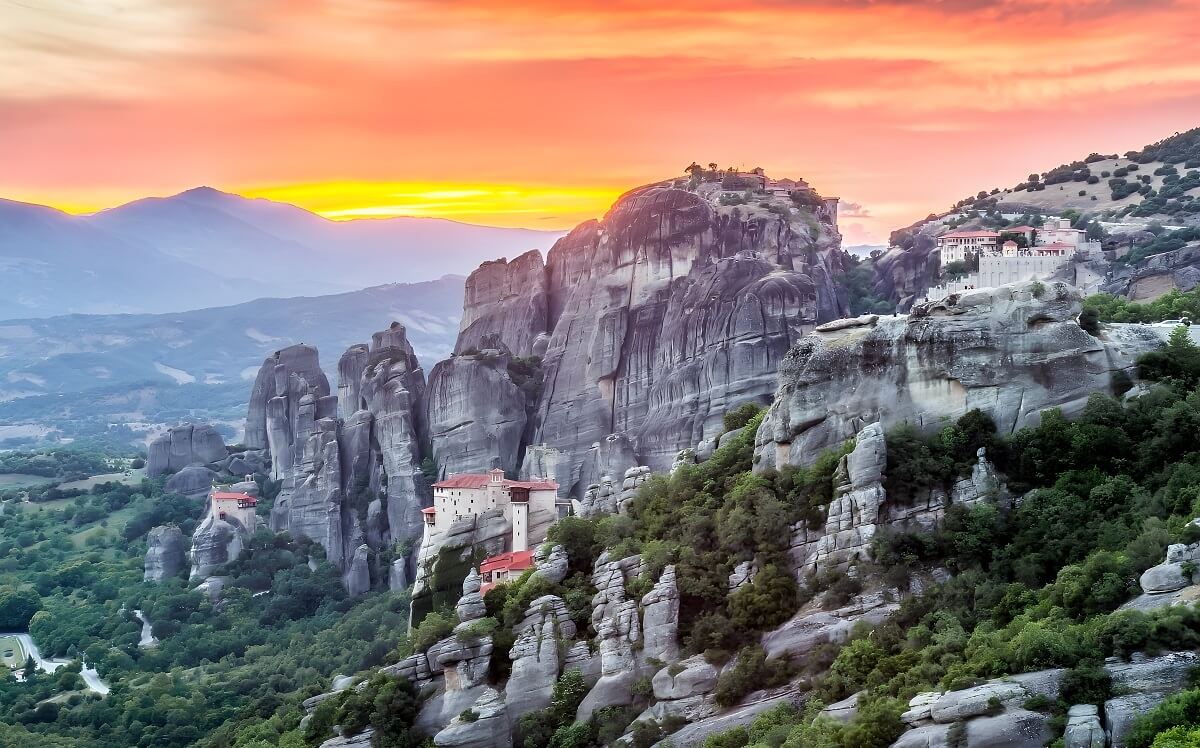

View from the first observation deck
From the second one:


View from the second observation deck
Both sites are very crowded in the summer. Some people come here an hour in advance to get the best seats at the front edge of the cliff. But there is no pushing – there is enough room for everyone 🙂 Children need special supervision here – the edges of the cliffs are not fenced and you can easily fly down a couple of hundred meters.