Samaria Gorge Crete: Everything about Europe's longest canyon including route options, practical preparation, transportation tips and personal journey through 18km trail
Updated:
Samaria Gorge is considered Crete’s second most famous attraction, but unlike Knossos Palace, it’s visited by far fewer people.
Samaria Gorge attracts trekking and nature lovers; for many it’s the main goal of their journey.
Before walking through Samaria Gorge, we had been to Crete 2 times and traveled the entire island by car. The third time we came to Crete in early September, including to visit this gorge.
In this article, I’ll tell you what Samaria Gorge is, how to get there by various means of transport, about our experience walking it on the long route (from Omalos Plateau to Agia Roumeli), and how to prepare for such a hike and what to take with you. And also, what to choose: long or short route? Go to Samaria Gorge independently or with a tour?
Samaria Gorge: key takeaways from this article
1. When to visit. Samaria National Park is open from early May to the end of October, from 6:00 to 16:00. The gorge may be closed due to weather conditions — rain or strong winds.
Around 200,000 people visit the park each year, the majority arriving in May and September–October.
2. The full route: what you need to know. The full Samaria Gorge trail is 18 kilometres long. With rest stops, this distance takes 5–7 hours to cover. The first 2 kilometres consist of a steep descent down stone steps with wooden handrails, which places considerable strain on the joints.
Tip: starting daily squats and stair climbing a week before the hike will help reduce the pain the following day.
3. How to complete the route. Most tourists hike the gorge from top to bottom: from the Omalos Plateau to Agia Roumeli. This can be done independently or as part of a ready-made excursion from Chania.
The gorge is located on the south-western coast of Crete and is easily accessible from the Chania and Rethymno regions. If you are staying in eastern Crete — in Heraklion, Agios Nikolaos, Elounda or Ierapetra — an independent trip makes little sense given the distances involved. It is better to use a ready-made excursion with return transfer.
We personally set off on an excursion from Panormos, near Rethymno. A comfortable coach, a briefing during the journey, a meeting point in Agia Roumeli after completing the gorge, a ferry crossing to Chora Sfakion and a return by bus. Gorge entrance tickets (€5) and the ferry (€11) are paid separately, as is lunch if desired.
4. Route description: 9 key points
- The trek begins at an altitude of 1,230 metres above sea level. It is cool at the top and can be cold in the morning. The first section is a 2 km descent down stone steps with wooden handrails.
- First stop — Neroutsiko (1.7 km) — where you can refill your water.
- From the Agios Nikolaos car park to the village of Samaria — 3.7 km. Several drinking water springs along the way.
- The abandoned village of Samaria sits roughly at the halfway point (7 km from the entrance). Everyone takes a longer break here.
- From the 9 km mark, the path follows a riverbed, with rocks and small bridges between steep cliffs.
- The last stop with toilets, wells and shaded tables — Christos (11 km).
- A few minutes further on is the narrowest point of the gorge — the Iron Gates (Portes). Just 3.5 metres wide. From here it is less than 1 kilometre to the exit. This is where hikers from Agia Roumeli begin to appear.
- At the exit you must hand in the second part of your ticket, to count how many people entered and exited. Remaining in the gorge after 16:00 is prohibited. Near the exit there is a café where everyone buys freshly squeezed orange juice (€3) and “I survived Samaria Gorge” T-shirts (€8–10 after bargaining, not €15).
- The last 2 km to Agia Roumeli can be covered by bus for €2, but the road is flat and we practically jogged this stretch. At the end of the route — the Libyan Sea! The beach at Agia Roumeli is stony, but the water in September was perfect. The beach has changing rooms, sun loungers and umbrellas — all free if you buy drinks at the taverna.
The ferry to Chora Sfakion passes through the village of Loutro, which can only be reached by sea. The return journey north is winding, with beautiful views of the coastline and the sunset.
5. Shorter routes for those who do not want to walk all 18 km. There are several options for those not up for the full route:
The first 4 km from the entrance — you can walk from the Omalos Plateau to the Agios Nikolaos stop and turn back. This is the shortest route, but the upper part of the gorge is a steep staircase descent and the most beautiful sections are further along. This is the only option for those who arrive around 13:00.
The “lazy route” — a more popular alternative. From Chora Sfakion you can take the ferry to Agia Roumeli and then walk the lower section of the gorge to the Iron Gates (3.5 km). If you want to go further, arrive in Agia Roumeli the day before and stay overnight. You will be able to swim in the Libyan Sea, enjoy the peace and quiet, watch the sunset and walk the gorge in the morning without any oncoming traffic.
The lower section of the route can also be started from Sougia or Paleochora. Ferries from these places to Agia Roumeli depart earlier, giving you time to reach the most beautiful spots and return within a single day.
6. How to get to the gorge
By bus from Chania: buses on the Chania–Omalos route depart in the morning from the main bus terminal. A ticket costs €7.50 and the journey takes around 90 minutes — the first bus departs at 6:15.
Return: the ferry from Agia Roumeli to Chora Sfakion departs at 17:30, costs €11 and takes 1 hour. A bus to Chania waits for the ferry’s arrival — ticket €8.30, journey approximately 1 hour 40 minutes.
By car: to enter the gorge ahead of the organised groups, you need to set off very early in the morning, while it is still dark. The road from the northern coast to the Omalos Plateau is mountainous with sharp bends. Many people arrive the day before and spend the night in the village of Omalos with views of the White Mountains. Parking at the park entrance is free. From Chania it is better to travel via Alikianou rather than directly — the road is less winding, though it adds 15 minutes. Aim to arrive by 7:00, as parking spaces may be gone later. For detailed information about renting a car in Crete, see this article.
Excursions to Samaria Gorge. Almost all options, even the cheapest, include group transfer there and back as well as a guide’s escort. There is no need to walk the gorge as a group — everyone moves at their own pace, with the guide walking at the rear. Excursions last a full day.
From the Chania and Rethymno regions: from Chania — a full-day excursion to Samaria Gorge for €35–36 (depending on departure point, with over 20 pick-up locations available); from Rethymno — a full-day trek to Samaria Gorge for €32–36 (8 departure points including Rethymno itself).
From central Crete: a walking excursion in Samaria Gorge — €40–75 (over 15 departure points); from Agia Pelagia, Heraklion or Malia — a walk in Samaria Gorge for €48 (24 towns and villages from which you can be picked up by bus); from Agia Galini/Matala — a walking excursion in Samaria Gorge for €67.
All excursion options for Samaria Gorge can be found at the link above.
Samaria Gorge Crete
Samaria Gorge is Europe’s longest gorge. Its length is 16 km, and its beauty defies description. Before deciding to walk this challenging route, find out what awaits you and prepare properly.
Samaria Gorge was geologically formed more than 2 million years ago, when under the influence of tectonic processes Crete island acquired its shape. Since ancient times, people lived in the gorge; it also served as a refuge from Turkish yoke, German occupation, and civil war.
In 1962, Samaria Gorge received national park status. At the same time, all residents of Samaria village were resettled and it was opened to visitors.
Samaria National Park is a UNESCO protected territory; unique plants grow here and rare animals live here, the most famous of which is the wild Kri-kri goat.
The reserve is visited by about 200,000 people per year.
When is Samaria Gorge open?
Samaria National Park is open from early May to late October from 6:00 AM to 4:00 PM. The gorge may be closed due to weather conditions (rain, strong wind). Current information is on the official website.
Best time to visit Samaria Gorge: May, second half of September-October. In May plants bloom; in autumn you can swim in the sea. In July-August it’s very hot and there are the most people.
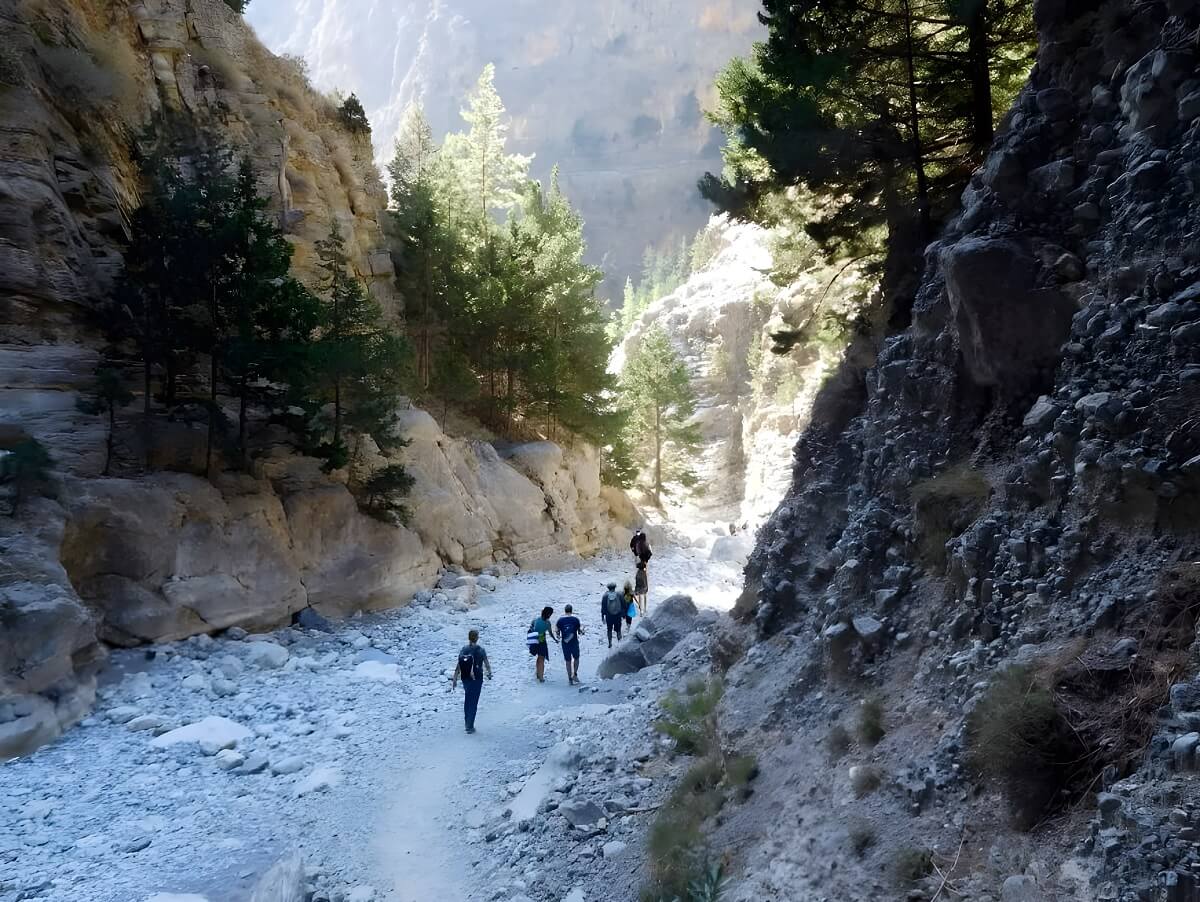
Samaria National Park is visited by about 200,000 people per year – most of them come here in May and September-October, when it’s not so hot in this area
Samaria Gorge routes
The full Samaria Gorge route is 18 km. This distance with rest stops is covered in 5-7 hours. Trekking through Samaria Gorge requires good physical fitness and proper equipment.
Don’t go hiking if you have health problems (especially with legs and knees) or poor health.
This route is not recommended for people leading sedentary lifestyles, the elderly and children. Don’t plan activities for the next 1-2 days after the hike; legs need to rest (they only don’t hurt for trained athletes).
Long route
Most tourists walk through Samaria Gorge from top to bottom: Omalos Plateau – Agia Roumeli. This trekking can be organized independently or you can join a tour.
Samaria Gorge is located in southwest Crete; it’s convenient to reach it from Chania and Rethymno regions. Going independently from Eastern Crete: Heraklion, Agios Nikolaos, Elounda, Ierapetra makes no sense due to large distances – better to take a tour with transfer there and back.
Short routes
For those who don’t want to walk all 18 km, there are several options:
- Walk the first 4 km from the entrance at Omalos Plateau to Agios Nikolaos stop and return. This is the shortest but not the most successful route. The upper part of the gorge is a steep descent down stairs; all the beauties are further. The only possible option for those who arrived around 1:00 PM.
- The “lazy route” is more popular. From Hora Sfakion, sail by ferry to Agia Roumeli. Walk the lower part of the gorge to the “Iron Gates” (3.5 km).
If you want to go further, come to Agia Roumeli the day before with an overnight stay. You can swim in the Libyan Sea, enjoy the silence, watch the sunset, and in the morning walk through the gorge without oncoming flow and return by ferry to Hora Sfakion.
3. The lower route can be started from Sougia and Paleochora. Ferries from these settlements to Agia Roumeli depart earlier; you’ll have time to reach the most beautiful places and return, within one day.
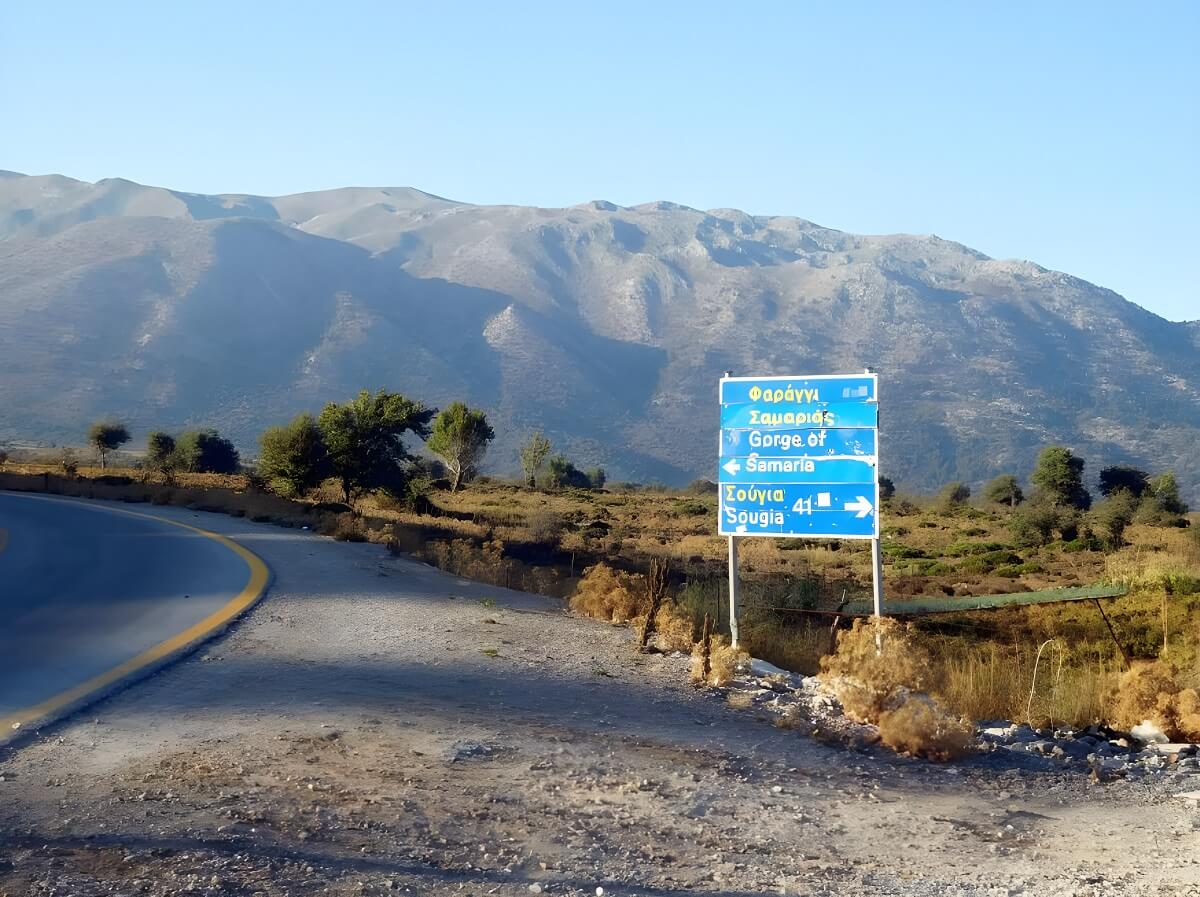
Omalos Plateau – starting point of the long route through Samaria Gorge
Samaria Gorge independently
You can come to Samaria Gorge independently by bus or by car. The route with entrance to the gorge at Omalos Plateau is suitable for those who live in Chania and/or rent a car.
By bus: Chania-Omalos (Samaria Gorge) buses depart in the morning from Chania central bus station. The ticket costs 7.50 euros, traveling about 90 minutes.
Ferry Agia Roumeli-Hora Sfakion departs at 5:30 PM, ticket cost 11 euros, travel 1 hour.
Bus to Chania: Sfakia (Chora Sfakion)-Chania waits for ferry arrival. Ticket costs 8.30 euros, travelling approximately 1 hour 40 minutes.
Return route: ferry Agia Roumeli-Sougia – bus Sougia-Chania goes through Omalos Plateau.
I have an article on my website about bus service in the Chania area; I recommend reading it.
By car: To enter the gorge before organized groups, you need to leave early in the morning when it’s still dark.
The road from the North coast to Omalos Plateau is mountainous, with sharp turns. If you get motion sickness, have breakfast and take a pill.
Many arrive the day before and spend the night in Omalos village with a view of the White Mountains.
Parking before the entrance to the national park is free.
If you’re going to travel around Crete by car, I recommend reading my article about car rental on Crete island, where I described all our experience in this matter (we rented a car on this island three times).
Walking through Samaria Gorge
An entrance ticket to Samaria National Park costs 5 euros. With the ticket, you get a free booklet with a map and information. Our route consisted of 10 points:
- Xyloskalo (upper entrance);
- Neroutsiko;
- Riza Sykias;
- Agios Nikolaos;
- Vrissi;
- Prinari;
- Samaria;
- Perdika;
- Christos;
- Ag. Roumeli (exit).
You need to walk at a measured pace only on the trail, always looking under your feet, stop for viewing and photographing, rest at stops, and quickly pass places with the threat of falling stones.
Trekking starts at an altitude of 1,230 m above sea level. It’s shady at the top and cool in the morning.
Descent – 2 km down stone steps with wooden railings. We entered with a stream of people who then dispersed throughout the gorge.
First stop Neroutsiko (1.7 km), you can get water; it’s not recommended to linger long.
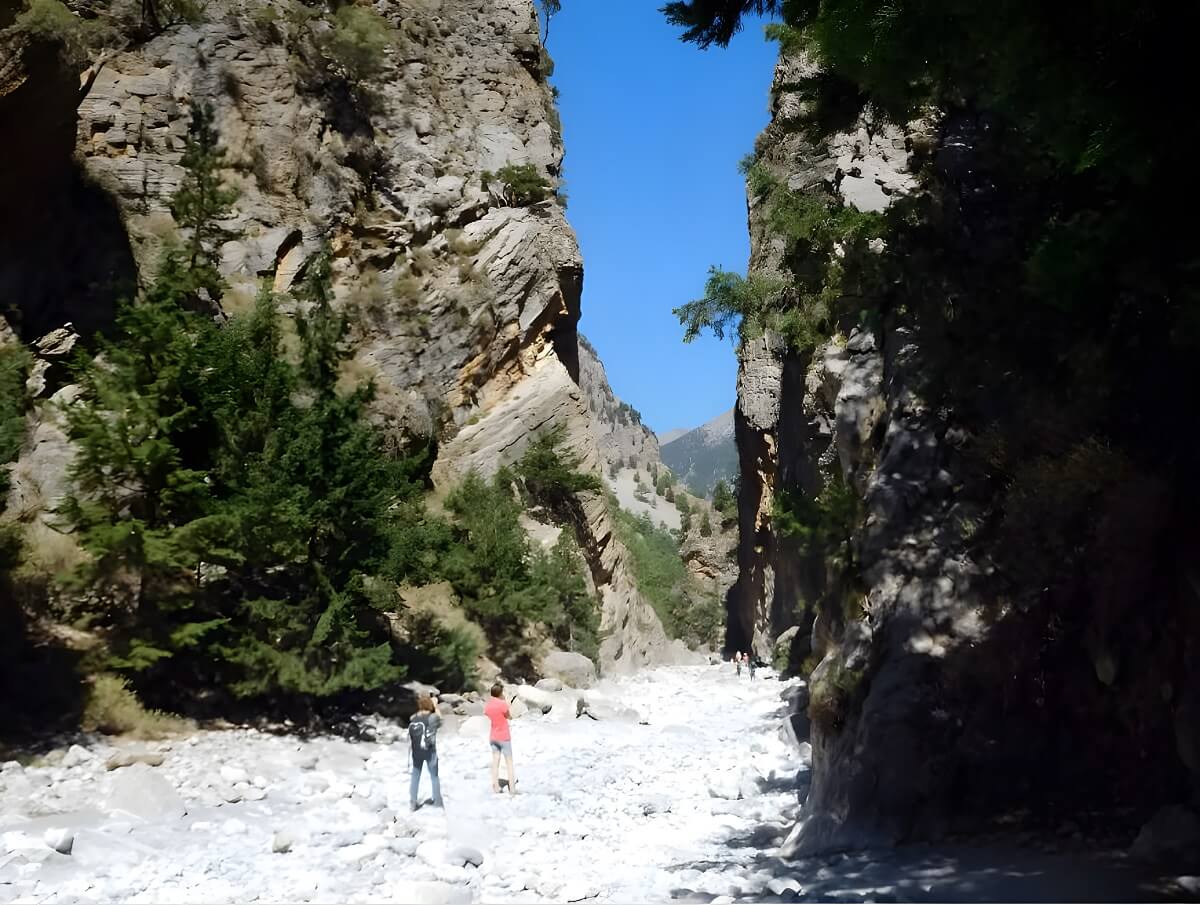
These impressive sheer cliffs can be seen on the second section of the route through Samaria Gorge (starting from 9 km)
It’s better to make a stop at Agios Nikolaos (3.5 km) and at the same time inspect the ancient Church of Saint Nicholas, built on the site of Apollo’s temple. If something happens, from this point you can return back on foot or by mule.
Tour buses wait 2 hours after arrival. Further you can only go in one direction – to the sea.
In our group, one girl felt ill; she was taken away by mule to the bus. Fortunately, nothing serious – everyone rode back together.
From Agios Nikolaos stop to Samaria village – 3.7 km. Along the way there will be several sources with drinking water.
Deserted Samaria village is located approximately in the middle of the route (7 km from the gorge entrance). Here everyone takes a big break. The approach to the village passes through a bridge.
Here preserved are ruins of buildings, olive trees, Church of St. Mary of Egypt, after whom the gorge is named.
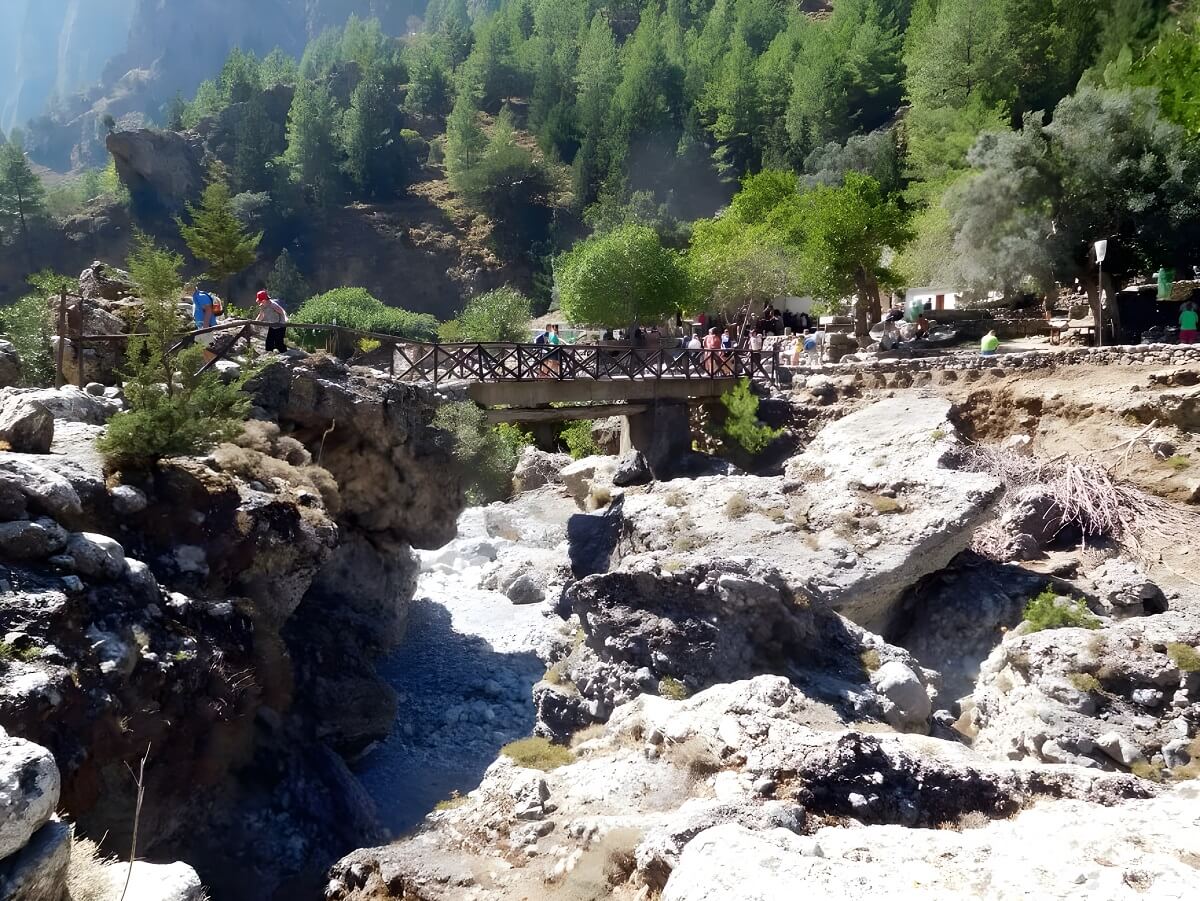
Samaria village – here usually all groups take a break as this place is approximately in the middle of the long route
We met with our guide Kostas; he said we shouldn’t rest longer than 30 minutes – it will be hard to walk later. In the village, Kri-kri goats approach people begging for food; we saw a goat with large horns.
The second half of Samaria Gorge is the most impressive, which helps to reach the end. Starting from 9 km, the trail passes along the riverbed, stones and bridges between sheer cliffs. In winter there’s no road here due to water, and previously village residents walked mountain trails.
Last stop with toilets, wells and tables in the shade of trees – Christos (11 km). But it’s better not to sit here long; strength is running out.
After a few minutes will be Samaria Gorge’s narrowest place – Iron Gates (Portes). Its width is 3.5 m. From here the distance to the exit is less than 1 kilometer. Tourists from Agia Roumeli are coming towards you (short route).
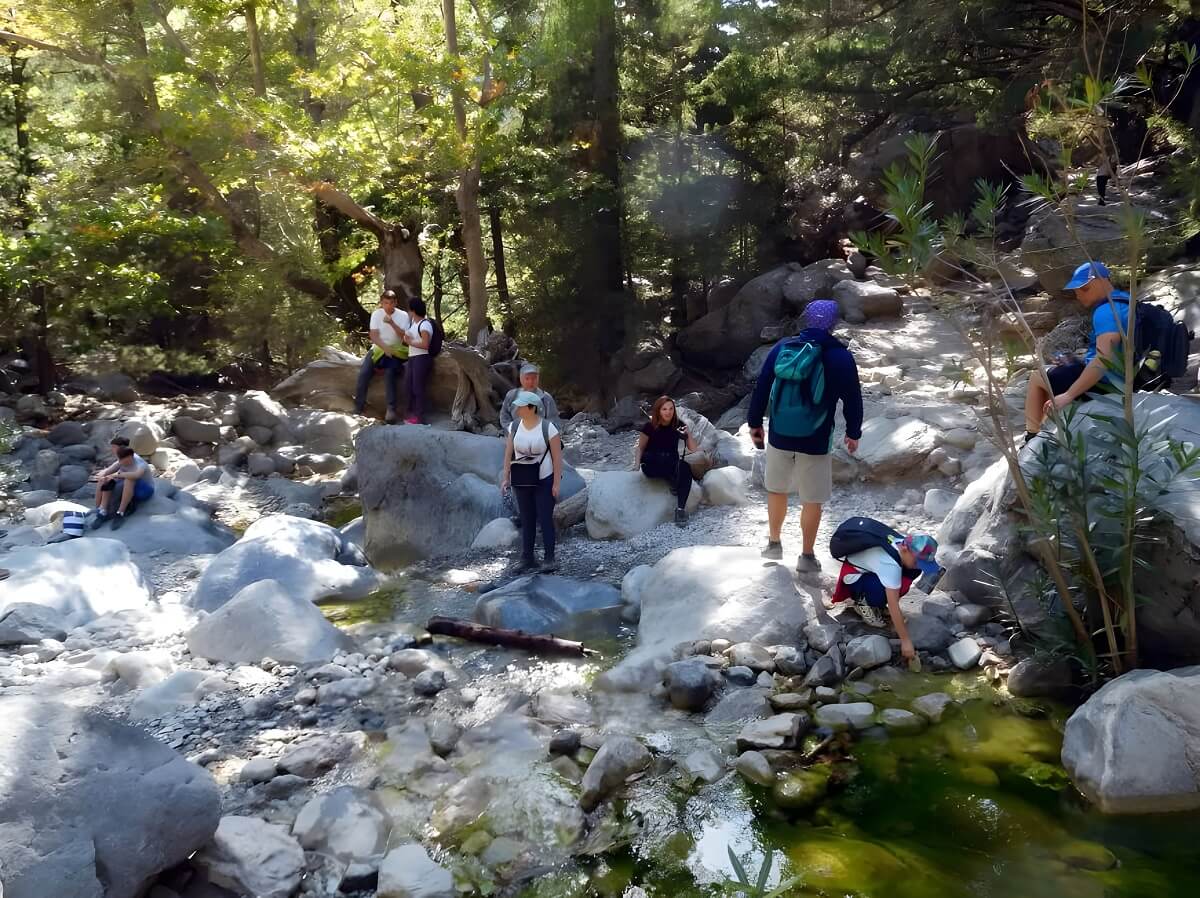
Our break
At the exit, you need to give the second part of the ticket so they count how many people entered and exited. You can’t stay in the gorge after 4:00 PM.
At the exit there’s a cafe where everyone buys freshly squeezed orange juice and “I survived Samaria gorge” t-shirts.
The last 2 km to Agia Roumeli can be reached by bus for 2 euros. The road is flat; we practically ran it.
At the end of the journey – the Libyan Sea! Agia Roumeli beach is pebbly; water in mid-September was perfect. On the beach there’s a changing room, sun loungers and umbrellas – all free if you buy drinks.
We walked through Samaria Gorge in 6.5 hours and had 1.5 hours left before the ferry. During this time we managed to swim and have lunch at a tavern.
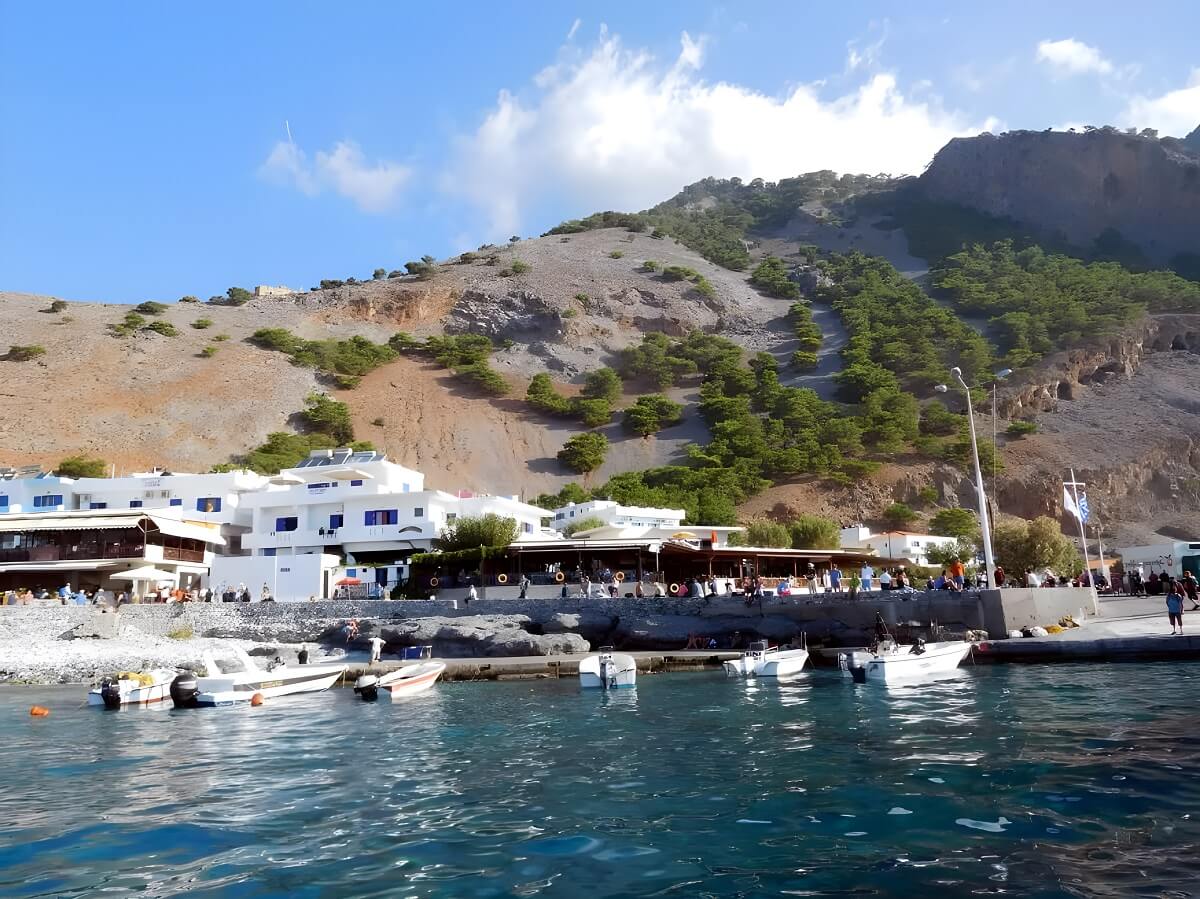
Agia Roumeli – end point of the long route through Samaria Gorge
The ferry to Hora Sfakion passes Loutro village, accessible only from the sea.
The return road to the North is winding, with beautiful views of the coast and sunset. We arrived at the hotel already in complete darkness.
As Cretans say: “Crossing Samaria Gorge is like visiting all of Crete.” And we did it. I highly recommend you repeat our experience.
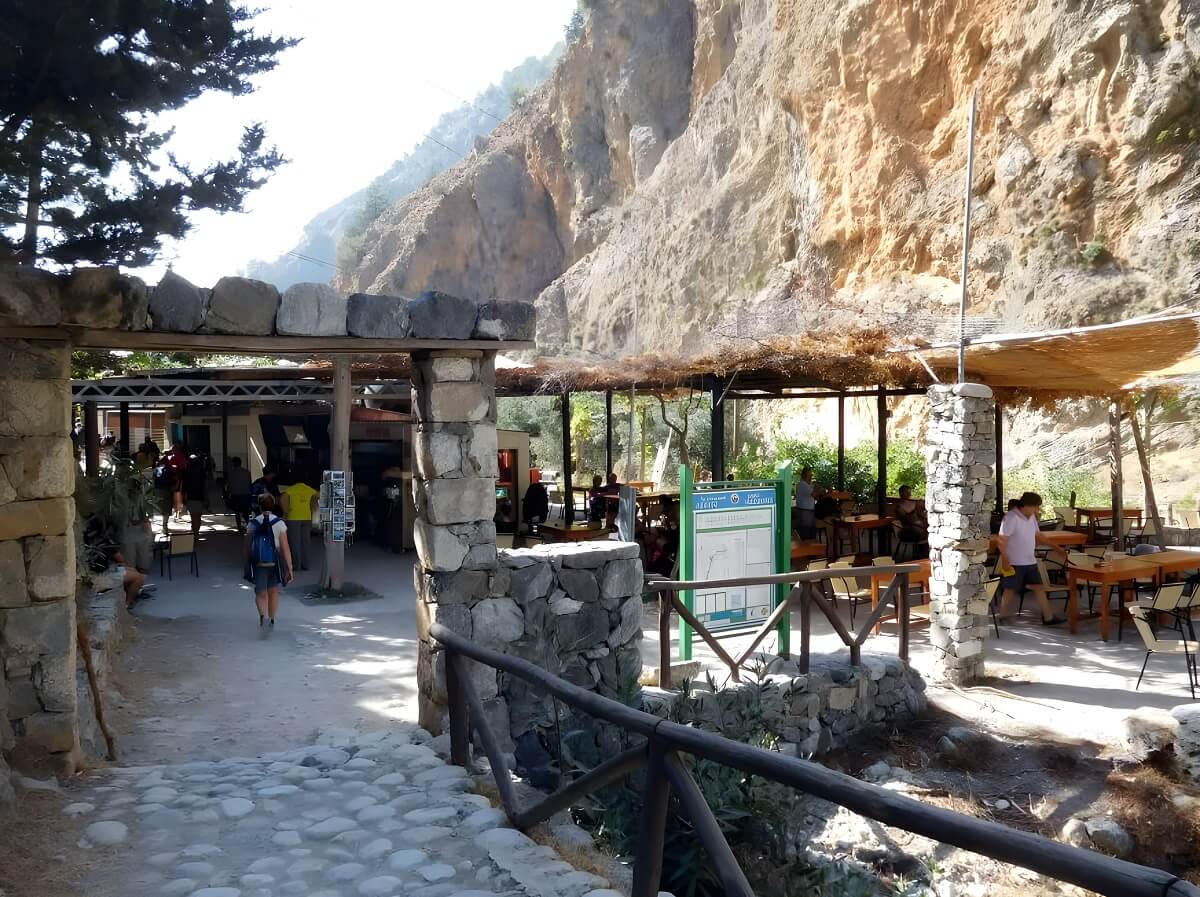
Exit from Samaria Gorge
How to dress for the gorge hike?
The main thing is comfortable closed shoes. Having special trekking boots is not mandatory. Choose shoes with thick soles and good foot support – you’ll have to walk on stones. Sandals and flip-flops are not suitable.
For upper clothing, it’s best to wear shorts and a t-shirt, take a hat and swimsuit. The hike starts early in the morning when it’s still cold, so many arrive in pants and windbreakers.
What to take with you?
Food: sandwiches, fruit, a bottle of water. Nothing is sold in the gorge. You can pour drinking water at springs, so there’s no need to take a large bottle.
Take a band-aid in case of cuts or blisters, sunscreen. Also, take sufficient money: for ticket payment, lunch after exiting the gorge, transport and various unforeseen expenses.
For all of the above, you’ll need a small backpack.
If walking through Samaria Gorge seems difficult to you, but you want to participate in non-mass tourism and take children with you, go on a tour to neighboring Aradena Gorge.
There a three-hour hike through the picturesque White Mountains awaits you, lunch at a tavern and swimming at Marmara beach.
Samaria Gorge on map
Location of Samaria Gorge on Crete map