Spinalonga Island and Olous: Complete Travel Guide to the Fortress Island and Ancient Sunken City with Routes, Prices and Personal Impressions from Eastern Crete
Updated:
In this article I’ll touch on two historical places on the island of Crete that will amaze impressionable tourists and show the dark side of Greek history, namely the fortress island of Spinalonga and the sunken city of Olous.
I also decided to visit these places. And in today’s article I’ll share my impressions from this trip. I’ll tell you where these attractions are located and what’s the best way to get to them, about tours, what you can see here and other useful information for tourists.
Table of contents
What you can see when visiting Spinalonga Island and the sunken city of Olous
The Greek Atlantis or, in other words, Olous especially flourished, according to various sources, during the Minoan period (3000-900 BC). This city, despite being essentially invisible, is one of the most important places in Crete. The ruins of the ancient city can still be seen at the bottom of the Poros channel.
Spinalonga is an island with ragged contours, located right off the coast in the eastern part of Crete. In 1579, the Venetians built a fortress on the island to protect Spinalonga Bay and Mirabello Bay. The fortifications were erected on top of a hill, which made the fortress on the island impregnable.
Spinalonga is a remnant of land on which the city of Olous was located and which went underwater after an earthquake.
On this wonderful island, which has seen many sieges and events in its history, there’s much to see. On Spinalonga there are still buildings and fortifications being restored, however the island has been recovering for about seven years! Slowly but surely, step by step.
Might be useful: I have an article on my website about Heraklion, as well as about Crete in general, where I talked in detail about transport, attractions and other useful information for tourists. You can view them by following the links.
Spinalonga fortress island
Plan of Spinalonga fortress island
Spinalonga fortress is well preserved, and from the top of the hill on which it’s located, a beautiful view of the sea opens up.
Some buildings have been restored and renovated. On the island there are cafes, souvenir shops, a sports equipment rental center, and toilets.
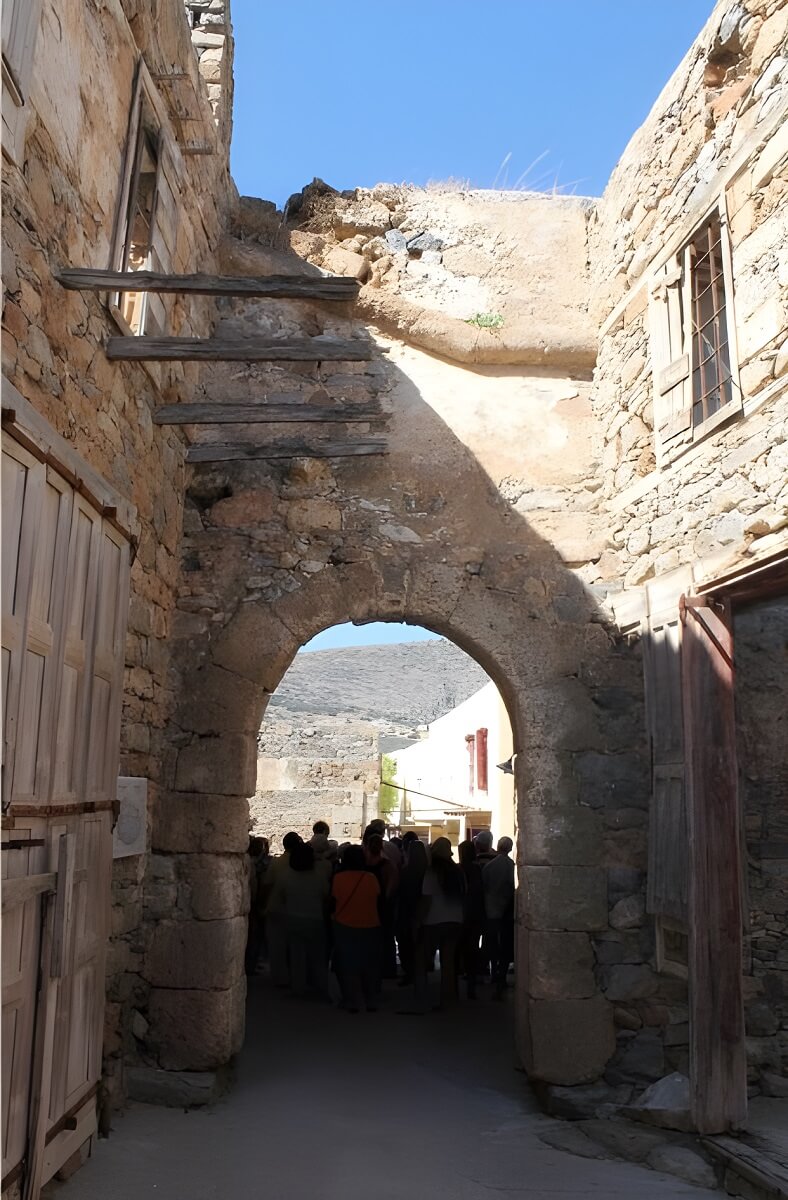
The streets on Spinalonga are narrow and picturesque. There are a huge number of arches, dried and half-dried trees, particularly palms.
By the way, if you walk around the island in a circle, which we actually did, you get a funny number: just one kilometer! But in this kilometer you can not only look at the island itself from the inside, but also see the picturesque views of its neighbor – Crete!
On this island there’s another small church, there’s a fortified tower that’s under restoration, there are various plants, like cacti. But that’s not the main thing! The main thing, you won’t believe it, is sea urchins! They look so interesting from above! Even though I saw them only from afar, only on Spinalonga – I liked them, and that’s undeniable!!!
Tip: Don’t forget to climb to the upper bastion, look out through the loopholes at the blue of the sea and take photos on the edge of the walls.
A selection of shots from the trip to back up my words above: narrow streets (photos 1 and 2); building reconstruction (photos 3 and 4); a small church you can visit and pray (photo 5); and, of course, incredible sea urchins and their view from above to the shore (photo 6)
Why the Spinalonga fortress island is called the "Island of sorrow and sadness"
By 1900, Spinalonga was already sparsely populated. Three years later, the Cretan government signed a decree to establish a colony for lepers here. The arrival of the first batch of patients became a more effective means of expelling the last remaining Turks from the island than an armed attack. In those times, leprosy caused almost superstitious horror. And the opportunity to live in relatively humane conditions in houses abandoned by the Turks became a truly merciful act for Crete’s patients.
The leprosarium on the island remained even after Crete became part of Greece, and patients were brought here from all over the country, and later from other countries. The circumstances of life in Spinalonga’s leper colony were nightmarish for a long time. Houses were in a semi-ruined state, and patients had no opportunities to repair them. There was a shortage of money, food, even drinking water. The situation began to change for the better only after World War II, and before that Spinalonga remained an island of tears and sorrow.
After the Americans discovered a cure for leprosy, the number of Spinalonga’s inhabitants began to decline, and by the mid-20th century the island became deserted. But despite its grim history, it has recently become one of Crete’s most popular tourist sites and is among the top five most visited Byzantine period attractions on the island.
View of Spinalonga Island (photo 1) and the Venetian fortress (photo 2) located on the island itself
The sunken city of Olous
Many will agree that much more could be done to increase the tourist attractiveness of this place, which has such enormous historical and cultural significance.
To see Olous, you first need to find it, and that’s not so easy. You won’t find any signs, pointers or even tourist brochures anywhere that would advertise this place. And in any case, going to Olous only makes sense in perfect calm: only then will you be able to see something through the water’s thickness. And it’s very, very unlikely that it will be the Minoan mosaic, enthusiastic mentions of which are found in internet sources. In the best and most likely case – just remains of walls.
Of course, you can try diving with a mask, but even in this case it would be good to have a very clear idea of where exactly to do this, and even local residents don’t know this.
Many tourists report that they saw a Minoan-era mosaic in front of a small church, next to a shop behind a farmer’s field. True, even more tourists report that they searched the entire field and found nothing of the sort.
Because of all this confusion and lack of development, very many travelers leave Olous (or so they think) disappointed – simply because they looked in the wrong place.
From practice I can say that the sunken city is located in the eastern part of Elounda, right at the isthmus that connects the mainland with Kalydon, which forms the eastern boundary of the bay. The landmark is the remains of windmills. But don’t go too far (toward Kalydon and the windmills): Olous is located closer to Elounda, very close to a nice promenade with benches and lanterns.
Location of ancient Olous port and its reverse side, Elounda
Interesting fact: It was Olous, or Olounda, that gave the name to modern Elounda.
Ticket prices for Spinalonga fortress island
The boat will go around the island and approach the southern pier, where you can disembark. Entry to the fortress territory at the top is paid.
General fee for entry to Spinalonga Island is 8 euros.
People over 65 from EU member countries and people under 25 from non-EU countries are entitled to a 50% discount and pay only 4 euros.
For persons under 25 from EU member countries, entry is free.
To get a discounted ticket or free admission ticket, you’ll need to present a valid ID or passport to confirm your age and country of origin.
How to get to Spinalonga fortress island
You can get to Spinalonga only by boat, renting independently or as part of a tour group:
from Agios Nikolaos (you can easily get to the city from Heraklion as part of a trip).
from the villages of Elounda or Plaka (from the latter it’s the closest ride – about 10 minutes).
Please return to the pier on time, because all ships here run on schedule, and they can’t always wait long for latecomers.
Example of a boat (photo 1) that can bring you to the pier (photo 2) of Spinalonga Island
How to get to the sunken city of Olous
Bus. By KTEL carrier buses to Agios Nikolaos town, then 10 km north.
Rental car. 70 km from Heraklion on highway No. 90 to the turn at Pissidos – you need to arrive in Elounda – landmark windmills, and then by intuition.
Might be useful: previously I wrote a large article about car rental in Greece, as well as a separate article about car rental on the island of Crete, which you can view and read by following the links
You can order a transfer, essentially it’s the same as a taxi, only you book the trip time in advance, choose the transfer pick-up location and the place where you need to go. You can book a transfer online on the Gettransfer website.
4. As part of a tour group
Location of the sunken city of Olous on the map
Did you like the article? Share it with your friends: