Spinalonga Tour on Crete: What the Island Actually Looks Like Inside, How the Guided Visit Works, What Surprised Us Most and Whether It Is Worth the Trip from Heraklion

Updated:

From Heraklion: day trip to Spinalonga island

Tour itinerary overview with approximate stop durations:

The tour starts at 8:00 AM. The guide picks up tourists from hotels in Heraklion and Agios Nikolaos cities.

The first stop of the tour is the town of Elounda. Here there will be a transfer to a boat to Spinalonga island.

Unfortunately, entrance tickets to the island itself are not included in the tour price (ticket costs 8 euros), but the guide will be able to take you to the ticket office without queuing.

During the walk, the guide will take you around the entire island and tell you all its stories and legends.

After the tour to Spinalonga island, there will be an opportunity (optional) to visit Kolokytha sandy bay (12 euros per person), as well as take a walk around Agios Nikolaos.

Price: 48 euros per person, for children aged 2 to 12 years – 25 euros per person (regardless of season)

Duration: 10 hours including stops

What’s included in the price:

  • Professional guide
  • Air-conditioned bus
  • Boat ticket
  • Sandwich, croissant, juice, and water

What’s not included in the tour price:

  • Entrance tickets to Spinalonga excavations (8 euros per person)
  • Cruise and BBQ lunch in Kolokytha bay (12 euros per person)

Book a tour from Elounda and Plaka to Spinalonga island

Table of contents

Beginning of our trip to Spinalonga island from Elounda town

Might be useful: on our website we’ve already written an introductory article about Spinalonga island, which you can view via this link

Since our main stops on this trip were Knossos Palace (there’s a whole article about visiting it on the site), Spinalonga island, and Agios Nikolaos, we decided to book a room in Heraklion rather than in our beloved Chania (no one travels from Crete’s western coast to Spinalonga).

From here it’s convenient to reach these two places, and during breaks between trips you can lie on an excellent beach.

When you plan your trip to Spinalonga island, you can also stay in Elounda or Plaka. The latter village is very famous for its fish taverns, so after returning from Spinalonga, you can enjoy the view of this island from a tavern terrace.

But there’s a significant downside – prices in Plaka taverns are quite high. So look for an establishment within your budget.

The drive from Heraklion to Elounda is relatively short – about an hour. All transport on Crete is comfortable, with air conditioning, tinted windows, and other pleasant amenities, so the journey is completely effortless. And even if we had traveled longer, we wouldn’t have experienced any discomfort. The transport here is designed for long trips. I can’t help but mention the views from the window – Greece looks gorgeous along the way!

So, the guide was waiting for us near Windmill small port at 9 AM. When we arrived, a group, guide, and boat were already waiting for us, on which we were to stop at Plaka and pick up other tourists. From there we immediately headed to Spinalonga island.

As I already mentioned, Spinalonga island is located almost directly opposite Plaka village, from where it’s clearly visible. Without guided tour accompaniment, there’s nothing to do on the island. Well, you’ll walk around, look at the crumbling houses, but understanding what’s what is difficult. I recommend going as part of a group.
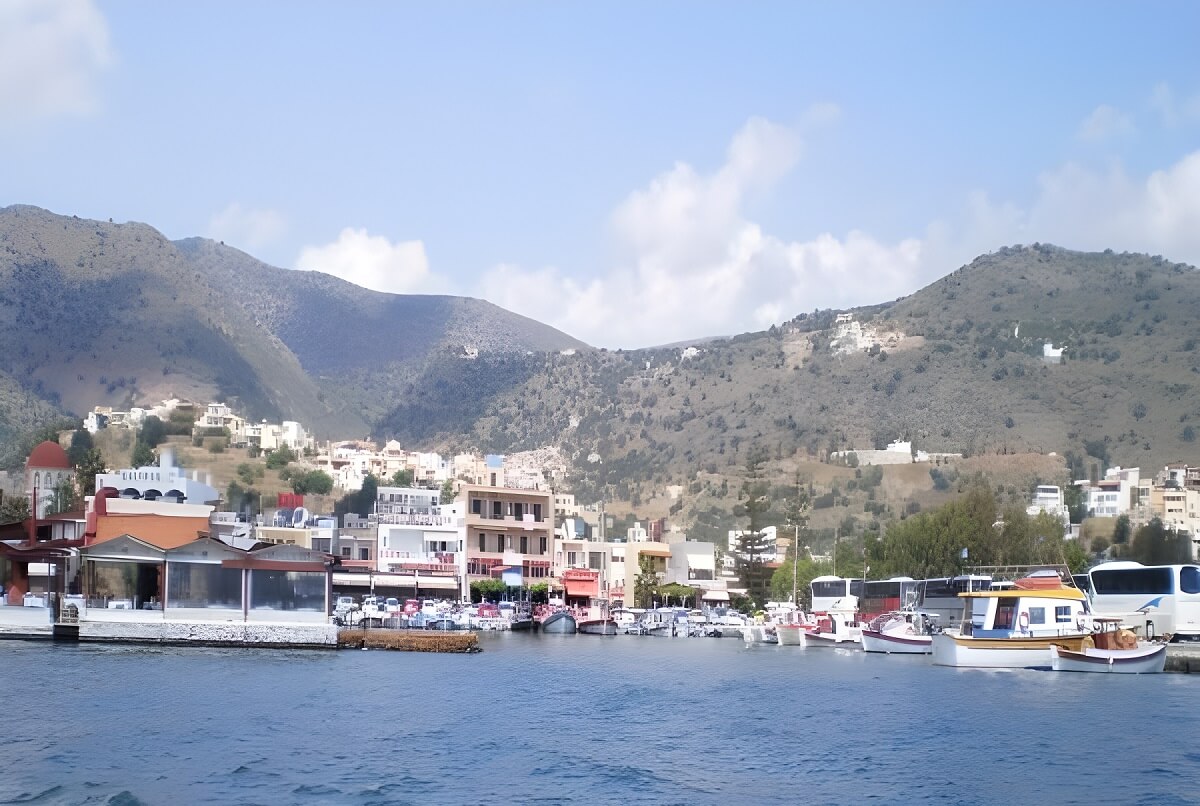
As we sailed away from Elounda, we were already anticipating seeing this special island. Its history is impressive, and we wanted to see this once-closed island with our own eyes as soon as possible

Attention: take water, a hat, and a shoulder cover with you! There’s no water on the island (there’s a kiosk, but water there is extremely expensive and it’s not always open). The island is exposed; walking around it you’ll constantly be under direct sunlight for several hours, you’ll have to walk around the island.

Arrival at Spinalonga island and introduction to its history

There are two approaches to the island. If you sail from Agios Nikolaos, you’ll sail around the entire island; if you sail from Elounda – only one side of the island will be accessible to you, same with Plaka.

The water on the way to the island is a special attraction; I couldn’t tear myself away from it for a long time, missing many interesting buildings on the nearby shores. Actually, seas and oceans have always impressed and frightened me at the same time – very beautiful and very deep, which is scary

Now a few words about the history of this place

The fortress, of course, wasn’t built for lepers (when people with leprosy are on the island, enemies won’t climb there even without walls). It was built by the Venetians who ruled Crete until the 17th century, and it was so impregnable that it held its defense for several decades after all of Crete was already under the Turks. Eventually Spinalonga was surrendered, as it became clear that the weakening Venice would no longer win the island back.

The high impregnable fortress walls and sheer cliffs testify that this was an impregnable fortress.

Watchtowers in several places also indicate that the fortress was well guarded. The views, of course, are gorgeous. A fortress on an island is always cool.

Here we can already see the island from the fortress side, but we’re not approaching it, but the other side of Spinalonga. It’s hard to believe that people couldn’t come here before and such beauty was closed off from everyone

But it all started when Crete gained freedom from the Ottomans at the end of the 19th century. Since the Turks used Spinalonga for smuggling, they didn’t want to leave the island at all. Well, the Greeks approached solving the problem from another angle – they decided to settle lepers there.

The descendants of the Janissaries weren’t inspired by such a prospect, of course, and they quickly packed their things and sailed away, and a leprosarium was organized on Spinalonga, which existed until the beginning of the second half of the last century, when all its inhabitants either died or were cured.

At first there were no conditions there, no medicine, no help, limited amounts of food and drink, until a person appeared on the island who could reach the Greek government. People were assigned benefits and they became the richest among nearby villages, even helping relatives outside the island.

During the period when people with leprosy lived on the island, the infrastructure there was much better than now. There were coffee shops and a cinema. Even electricity appeared on Spinalonga earlier than on the rest of Crete.

And we’re actually approaching Spinalonga island. This part of the island faces Plaka village and is almost fully built up, while the side facing the open sea has practically no buildings.

If people lived on the island, they definitely wouldn’t be bored. Judging by the number of buildings, life could have been bustling and flourishing here

Our boat docked at the island and immediately people started running up to us insistently offering their tours; they probably didn’t understand we were already participating in another one. We politely declined and went with the guide to buy tickets at the ticket office.

In our tour, tickets to enter Spinalonga had to be bought separately. By the way, at the entrance there’s a map and brochures with information about the island, which can be purchased there as well.

Entrance tickets to Spinalonga are sold at a nice kiosk for 8 euros, free for under 18. The queue for tickets was quite large, but fortunately, in our tour, access to them was without queuing.

At the entrance you can familiarize yourself with a detailed map of the area and buy a ticket. People come here in crowds, so if you don’t know the life hacks, you can stand in line for a very long time

What you can see on Spinalonga island during the tour

Now briefly about what you can see on Spinalonga. First, Venetian fortifications. To reach some of them, you literally need to scramble over rocks. Very spectacular views open up from the bastions.

Second, the actual dead city. Half-ruined houses made of boulders are buildings from the Turkish period. Of course, the descendants of the Janissaries were deeply offended before leaving the island and broke everything they couldn’t take away.

Going up and down the ruins of Spinalonga, you could see all pieces of the island. In some places you can see that people lived here and tried to take care of this place as much as possible

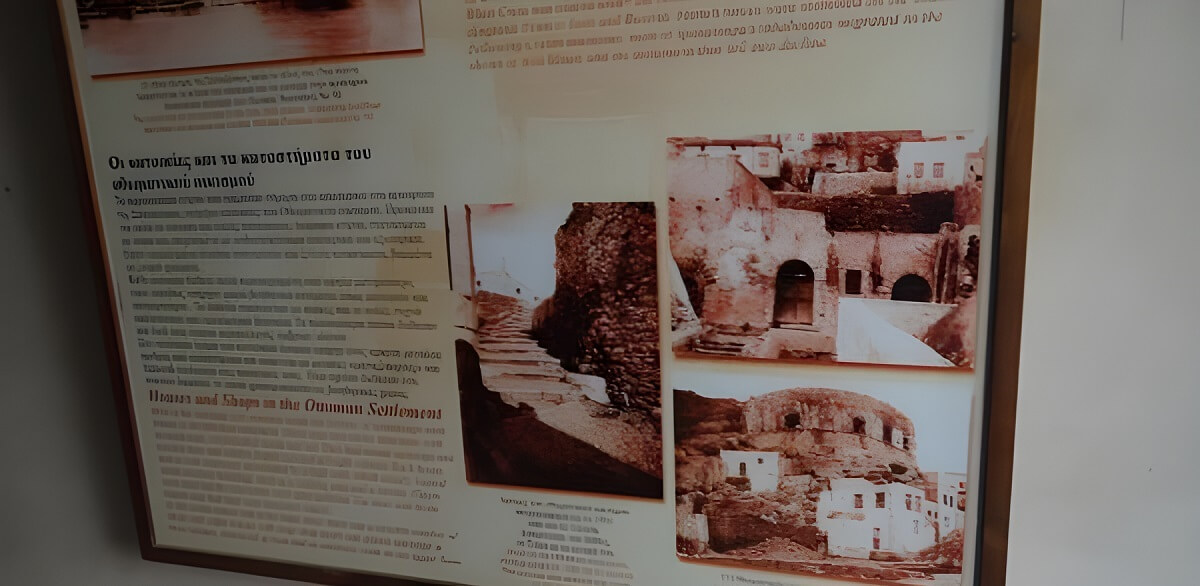
Buildings from the period when lepers lived on the island look newer. Some buildings have mini-museums. Rotted body parts of lepers aren’t displayed there, but quite interesting copies of photographs are displayed. Including from the Ottoman period.

Mainly, the island consists of a series of buildings of various purposes: from residential premises to storage facilities, weapons warehouses, stone cisterns with water supplies.

Walking along the island’s main street, you encounter very interesting buildings along the way. And we also made up a game for ourselves along the way: “Guess what kind of building that was”

Some houses have been restored, for example, those located on the island’s main street. This is where shops were located where people bought products. Now a small number of exhibits are displayed here, found after people left in 1957 (that year the last leper was cured). There are bakeries here where bread was baked and sold. There were also cafes, but women weren’t allowed in those times, because men’s issues were decided there.

The leprosarium was supplied with food and water by 2 neighboring villages; thanks to each other they survived. A reservoir was made for water storage. The laundry was right here too. Everything delivered from the island to the mainland went through sanitary processing in a special building with a domed roof.

People were treated in the local hospital; at first it was just one building, then another one was built nearby.

The hospital looks creepy, like from horror movies about abandoned psychiatric hospitals. I really wanted to see what’s inside and how they treated leprosy in those times, but the entrance to the hospital is blocked

And here in the distance you can see that very building where sanitary processing took place. But again, what and how they treated everything brought to the island – we never found out, though we would have liked to

In addition to the mentioned buildings, there are two churches on the island – St. George and St. Panteleimon. Services and weddings are still held in them on certain days. A wedding on the island, as the guide said, is an expensive pleasure for Greeks.

And, of course, the cemetery. Can’t do without it. This is where those who died from leprosy rest.

Upper left – St. George Church, right – St. Panteleimon Church, and below is that very cemetery where lepers were buried. Knowing the full history of this island, you no longer look at it simply as a cemetery

You can see a lot of evidence that people with leprosy worked here; there are several workshop buildings and several pottery kilns. People, despite everything, lived, created families, had children. Even though it was forbidden to them.

For a tourist to rest and sit down, there are very limited places here. And it’s very difficult to find shade. Prepare to always be under the scorching sun, which is exactly why I strongly recommended at the beginning of the article to bring covers with you.

This street became a real discovery for me here. Bright painted doors really catch the eye in such a place, because this is completely uncharacteristic of Spinalonga

There’s one more very interesting detail I didn’t mention at the beginning. Since 2013, a cross made of mirrors was installed at the fortress entrance on a sheer cliff. In addition, various glass fragments were installed in many fortress premises so that tourists could see their reflection.

This was done by one famous artist whose exhibition was taking place in the fortress at that time. This exhibition was dedicated to all those people with leprosy who were collected and sent to this island.

The disease was so dangerous that it simply consumed a person, making them hideous, and it’s known that at that time there were no mirrors on the island at all; people were afraid to see their reflection in the mirror. The artist tried with his mirror exhibition to emphasize that a mirror can reflect not only a face but also your soul.

Initially I imagined this cross a little differently; I thought it was made like a statue and stood right at the entrance. But this way this exhibit looks even more interesting

I’ll tell you honestly, I was gripped by horror and panic from these mirrors. The atmosphere is very oppressive; this place already has a very gloomy atmosphere, and then this cross with mirrors and their hidden subtext press down on you very strongly.

Although the sensations were creepy, with each step it became more interesting to explore this place. But, unfortunately, the cross and the figure of a soaring person at the top of the fortress – that’s all that remains on the island after the exhibition.

The fortress itself undoubtedly deserves attention. Be sure to climb the steps and look inside it. The most positive sight awaits you at the top of the fortress: from here, incredibly beautiful panoramic views of the sea, nearby villages, and even part of the island’s buildings open up.

Finally, we came to that very fortress that appeared to us when approaching the island. Here we had the most fun scrambling over rocks and climbing to its very top. And watching the neighboring islands from here is a separate pleasure

Personally, of course, besides the views from the fortress, we most enjoyed climbing through the ruins and looking into rooms of half-destroyed houses. Although we did have marks from these tricks on our legs and arms. But despite the pain, we completely walked this path and got a lot of impressions, both good and creepy.

Visiting tourists often have very different impressions of Spinalonga island. So I advise you to experience this journey yourself and have your own opinion about this place. What it will become for you – a historically interesting place or the last refuge of people doomed to death on this island from illness.

And, finally, I’ll give you one more motivation to come here as soon as possible – due to salty humidity and strong wind, the island is slowly collapsing, so make sure to visit it.

In the end, we still decided to visit Kolokytha bay and relax on the beach. After so many hours on our feet, we just wanted to lie down and not get up. We had several hours to lie around and rest, so those who wish can take towels and swimsuits with them. But we didn’t go for a walk around Agios Nikolaos; we had no energy left to walk and didn’t want to force ourselves to go anymore, so we just waited for the transfer and went back to Heraklion.

Did you like the article? Share it with your friends:
Facebook
Twitter
Pinterest
WhatsApp